
 This article is about the current villagers. For the documentation of villagers prior to Village & Pillage, see Villager (old). For other uses, see Villager (disambiguation).
"Merchant" redirects here. For other uses, see Merchant (disambiguation).
This article is about the current villagers. For the documentation of villagers prior to Village & Pillage, see Villager (old). For other uses, see Villager (disambiguation).
"Merchant" redirects here. For other uses, see Merchant (disambiguation).


Adult

Baby

Adult

Baby


| Health points | 20HP × 10 × 10
|
|---|---|
| Behavior | Passive[note 1] |
| Attack strength |
 Firework Rocket: Firework Rocket:Damage decreases with distance: |
| Hitbox size | Adult In Java Edition: Height: 1.95 blocks Width: 0.6 blocks Adult In Bedrock Edition: |
| Speed | 0.5 |
| Spawn |
|


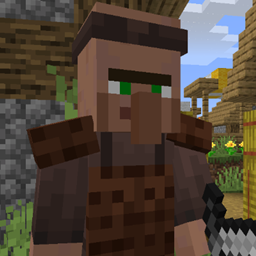
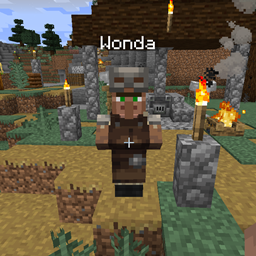
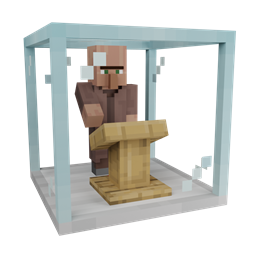
Villagers are humanoid passive mobs that inhabit villages, work at their professions, breed, and interact with each other. Their outfit varies according to their occupation and biome, and a player can trade with them using emeralds as currency, with their prices affected by reputation.
Spawning
Each villager spawns with an empty inventory. Villagers never spawn with armor or other equipment, but in Java Edition a dispenser can be used to equip armor on a villager.
Natural generation
Villagers can be found in villages, which spawn in several biomes such as plains, snowy plains, savannas, deserts, taigas, and snowy taigas[Bedrock Edition only] and can cut into other biomes such as swamps and jungles. When the village is generated, unemployed villagers spawn in them, the number of which depends on the buildings in that village, as some buildings generate villagers inside and some do not.
Igloo basements always generate with one villager in the left cell and one zombie villager in the right cell.
- In Java Edition, the generated villager is always unemployed.[1] The villager cannot pathfind to the brewing stand or cauldron to take on a profession unless some of the blocks confining them are broken. The generated zombie villager always has the profession of cleric and becomes unemployed once cured.
- Both mobs are the plains variant. See § Appearance.
- In Bedrock Edition, the villager has a random profession and the zombie villager is unemployed.
- Both mobs are the snowy variant.
- The villager can change its professions to cleric or leatherworker, due to the presence of the brewing stand and cauldron. The zombie villager can do the same after being cured.
- Changing profession takes time. If the player manages to trade with the villager before it changes its profession, the villager keeps its initial profession.
- The zombie villager is unemployed immediately after being cured, so the player cannot lock in its profession.
Curing
Giving a zombie villager the Weakness effect and then feeding it a golden apple starts the curing process. After five minutes, it transforms into a villager, displaying purple Nausea status effect particles for 10 seconds after being cured.
The villager retains the profession it had, if it had one before turning into a zombie villager. If employed, a cured villager offers discounts on most of its trades.
In Bedrock Edition, if the zombie villager is spawned by a player, it adopts a randomly chosen profession. The villager can also be a nitwit, but it becomes a normal unemployed villager when cured.
In Java Edition, curing a baby zombie villager riding a chicken results in the villager riding a chicken. Eventually, the villager grows up and can gain a profession while still being on the chicken.
Drops
Farmers using bone meal when farming have an 8.5% chance to drop it when killed by a player or tamed wolf. Each level of Looting increases the chance by 1% per level. Adult[2] villagers can drop armor equipped through dispensers. Otherwise, a villager, whether it is an adult or a baby, does not drop any items or experience when killed.
When a villager dies or is converted to a zombie villager, any items in its hidden inventory slots are lost (see § Picking up items).
If a villager is displaying a trade item to offer a deal, they will not drop it upon death. However, in Java Edition, carpets (held by shepherds), leather horse armor, and saddles (held by leatherworkers) can be removed using shears.[until: JE 26.4] Villagers do not drop any other trading-related items.
Upon successful trading, a villager drops 3–6XP.
Upon successful trading, while willing to breed, 8–11XP is dropped.
Curing a zombie villager with any armor or held items causes it to drop them as items.
Hero of the Village
In Java Edition, a villager can drop various items, depending on its profession, by throwing a gift toward a nearby player with the Hero of the Village effect. The gift is randomly selected from a list of items for the villager's individual profession, and there is a random cooldown before the villager can throw another gift.
Behavior
Movement patterns
Socializing
Nitwit and unemployed villagers leave their homes at day and begin to explore the village. Generally, they wander inside the village during the day. They may go indoors or outdoors, periodically making mumbling sounds. Occasionally, two villagers may stop and turn to look at each other, in a behavior called socializing, during which they stare at another villager for 4–5 seconds at a time. They continuously stare at a nearby player unless the villager is trying to get into a house at night, farm food, work, or flee from a zombie or illager. Baby villagers may jump on beds and play tag with each other, similarly to how baby piglins and baby hoglins play tag.
In Bedrock Edition, baby villagers do not stop in order to stare at players, and thus continue moving as if the player is not there.
A villager tries not to travel far from its bed in a large village unless the job site or the nearest gossip site (bell) is far away.
Villagers emit green particles if they join a village, set a bed, or acquire a job site/profession.
Villagers run inside at night or during rain, closing doors behind them. They attempt to sleep at night, but if they cannot claim a bed, they stay indoors near a bed until morning. In the morning, they head outside and resume normal behavior. However, some villagers, such as nitwits, stay outside later than others unless being chased by an illager or zombie.
Migration
If a villager finds itself outside the village boundary, or a villager without a village detects a village boundary within 32 blocks, it quickly moves back within the boundary. A villager taken more than 32 blocks away from its village boundary forgets the village within about 6 seconds. Whether in a village or not, a villager never despawns.
Pathfinding
Villagers, like most other mobs, can find paths around obstructions, avoid walking off cliffs of heights greater than 3 blocks, and avoid some blocks that cause harm. However, in crowded situations, one villager can push another off a cliff or into harm's way.
Villagers can open all wooden and copper doors and find paths to blocks of interest behind the doors. However, they cannot open any trapdoors, fence gates, or iron doors. Villagers can climb ladders, but do not recognize them as paths and do not deliberately use them. Any climbing of ladders seems to be a side effect of them being pushed into the block by another mob (usually by other villagers). Climbing a ladder can leave a villager stranded on the second floor and roof of some village structures, as they lack the necessary AI to intentionally descend ladders.
Getting attacked
Like other passive mobs, villagers sprint away when attacked, but they also flee from some nearby mobs even before being attacked.
Zombies, zombie villagers, husks, drowned and zoglins attack villagers and cause them to flee.
Pillagers, vindicators, evokers, illusioners and ravagers cause villagers to flee but only attack adults. Vexes also cause villagers to flee but only attack adults when spawned by an evoker.
Pufferfish, wardens and withers attack villagers but don't cause them to flee until actually attacked.
Preferred path

When pathfinding, villagers prefer to stay on low cost blocks, such as dirt paths, cobblestone, bricks, and planks. They do this by trying to minimize the path cost of all of the blocks they walk across. They also avoid jumping, because it has a high path cost, but babies don't avoid it as much.
| Preferred path blocks | Path cost | ||
|---|---|---|---|
| Adult villager | Baby villager | ||
 Dirt Path Dirt Path
|
0 | ||
|
|
|
1 | |
|
|
|
50 | |
| Other | 3 | 1.5 | |
| Jump cost | 20 | 5 | |


Job site blocks
For a list of job site blocks and the professions they are required for, see § Professions.
Unemployed villagers (other than babies and nitwits) seek employment at job site blocks (also referred to as workstations), and employed villagers use job site blocks to refresh their trades (see § Working). Villagers who have made their first trade must claim a site block that corresponds with their profession, whereas tradeless villagers may change their profession to match a site block.
In Java Edition, an unemployed villager claims job site blocks by searching for the nearest unclaimed site in a 48-block sphere. When a suitable site block is detected, the villager starts pathfinding to it, staking a provisional claim. This can occur only while the villager is awake. A provisional claim is released if the villager cannot reach the block within 60 seconds, however the villager may try again immediately.[3] To fully claim the site and change profession, the villager must approach within a 2-block radius of the job site's center. When a job site block is fully claimed, its owner emits green particles, and no other villager can claim the block unless the owner relinquishes it.
In Bedrock Edition, all villagers in a village search for unclaimed job sites in a 16 block radius and 4 block height. If a site block is found, it is added to a shared list of valid job site blocks for the whole village. An unemployed villager with a bed claims the first site block on that list and immediately acquires the profession to match, regardless of the distance or accessibility to the site block.[4] The villager can even claim the site block while sleeping. When a job site block is claimed, both the block and the villager making the claim emit green particles and the site block is removed from the list. If a villager cannot pathfind to its claimed site, both the site block and villager emit anger particles. The site block may need to be broken or interacted by a piston before the villager unclaims it.[verify for Bedrock Edition]
Gossiping
For the formula to calculate the exact price based on gossips, see Trading § Sale prices.

Villagers can store positive and negative[JE only] memories about players and share them with other villagers. A player's reputation is determined by these memories, and can be changed by trading with, curing, attacking[JE only] and killing villagers[JE only], which influences trading prices.
| Source | Internal name | Gain | Decay | Sharing cost | Maximum | Multiplier |
|---|---|---|---|---|---|---|
| Each trade | trading
|
4 | 2 | 20 | 25 | 1 |
| Curing the villager | major_positive
|
20 | 0 | 100 | 20 | 5 |
minor_positive
|
25 | 1 | 5 | 25 | 1 | |
| Attacking the villager | minor_negative
|
25 | 20 | 20 | 200 | -1 |
| Killing a nearby villager | major_negative
|
25 | 10 | 10 | 100 | -5 |
Killing a villager increases the value of the corresponding gossip for all villagers whom it has a line of sight inside a box extending 16 blocks from the villager in all coordinate directions.[JE only] Trading with, curing or attacking[JE only] a villager only increases the value of the corresponding gossips for the targeted villager. Attacks and kills only result in negative gossip[JE only] when villagers can determine their source, so indirect methods like fire, lava and suffocation from falling blocks can be used to kill villagers without losing reputation.
Villagers can share gossip by talking to each other, though the shared gossip's value will be decreased by the sharing cost. Because the cost of sharing the major gossip gained from curing is greater than its maximum, it can never be shared.
Every 20 minutes, all gossips of a villager decays by the amount in the "Decay" column. This rate does not depend on the time of day and cannot be sped up by sleeping. Because the decay of the major gossip gained from curing is 0, the gossip is permanent.
A player's total reputation with a villager is determined by multiplying each gossip's value by its respective multiplier and adding the results together.
When trading, villagers will change prices based on reputation. In Bedrock Edition negative reputation can only cancel out positive reputation and other price discounts but not increase the price.
Iron golems that were not built by players become hostile toward all players whose reputation is -100 or lower with any villager within a box centered on the golem and extending 10 blocks in every horizontal and 8 in both vertical directions.
Items of interest
Each profession can have certain items it is especially interested in. This does not have many mechanical effects, other than affecting which items villagers will pick up and share. Currently, only one profession makes use of this system:
| Profession | Items of interest |
|---|---|
 Farmer Farmer
|
 Wheat, Wheat,  Wheat seeds, Wheat seeds,  Beetroot seeds, Beetroot seeds,  Bone meal Bone meal
|
Picking up items
Each villager has eight hidden inventory slots, which are initially empty when the villager is spawned. A villager can fill its inventory slots with items it picks up.
In Bedrock Edition, a villager does not intentionally seek out items to pick up, but does collect any bread, carrots, potatoes, wheat, wheat seeds, beetroot, beetroot seeds, torchflower seeds, pitcher pods, and bone meal within reach. Only farmers can pick up seeds, wheat, and bone meal.
In Java Edition, a villager seeks out and picks up these items within 4 blocks:
- Items in the
#villager_picks_upitem tag. - Items with the
villager_foodcomponent. - Items of interest to the villager's profession.
The listed items are the only items villagers can pick up, although the /item replace command can put any arbitrary item into a villager's inventory.
If a player and a villager are in the pickup range of an item at the same time, the player always picks it up first. If several villagers are next to an item, the same one picks up the item every time. This behavior prevents villagers from successfully sharing food or breeding in a small space.
When killed or converted to a zombie villager, any inventory item of the villager is lost, even when /gamerule keepInventory is set to true.
If /gamerule mob_griefing is false, villagers cannot pick up items, and farmer villagers cannot plant or harvest crops.
Like other mobs, villagers have four slots for worn armor, separate from their inventory slots. An adjacent dispenser can equip armor, elytra, mob heads or carved pumpkins to a villager,[Java Edition only][5] but the armor is not rendered (except for carved pumpkins and mob heads). The equipment functions as normal; for example, a villager wearing an armor piece enchanted with Thorns can inflict Thorns damage to attackers, and a villager wearing Frost Walker boots is able to create frosted ice. If a villager is converted into a zombie villager, the armor it was wearing is dropped, though it may be able to pick it up and equip it again. A villager with Thorns III deals more damage to zombies that attacked the villager than the villager takes damage.
Nutrition
Different food items provide villagers with different amounts of nutrition points:


In Java Edition, this is controlled by the villager_food item component.
Villagers will not eat food until they are about to breed. When this happens, they will consume food items from their inventory, starting at the first inventory slot and working their way forward, until they have reached or exceeded 12 nutrition points, and then immediately spend 12 nutrition points on the act of breeding. Depending on how the food is ordered in the villager's inventory, this can leave the villager with unspent nutrition points for next time.
Sharing food

In Java Edition, when a villager is interacting with another villager, they will try to share items under the following circumstances:
- If a villager has 24 or more nutrition points in their inventory, and is either a farmer or is talking to a villager with fewer than 12 nutrition points in their inventory, the villager will try to share food items. (Unspent nutrition points outside the inventory are not considered.)
- If a villager is a farmer and the wheat in their inventory adds up to more than half a stack, they will try to share wheat.
- If the professions of the two villagers have any items of interest in common (including when they have the same profession), the villager will try to share items of interest.
When trying to share items, the villager will scan through its inventory for the first item stack that contains the correct kind of items, and which is either more than half the maximum stack size or more than 24 items. If the stack that is found is more than half the maximum stack size, the villager will throw half the items in the stack (rounded down) to the other villager. If the stack that is found is not more than half the maximum stack size, but is more than 24 items, the villager will throw enough items to reduce the stack size to 24. If no item stack of sufficient size is found, nothing will be thrown.
There is no delay between sharing attempts, so a villager may continue throwing more items immediately if they are still eligible. For example, a villager with 60 bread may throw 30 bread (half the stack size), and then immediately throw 6 more bread (30 − 24), throwing a total of 36 bread. The other villager can also share items, until all villagers have shared all items they can.
Since sharing will never empty an inventory slot, the only way villagers can free up inventory space for new items is by eating food during breeding, or by planting seeds and using bonemeal if they are a farmer. If a non-farmer picks up seeds or bonemeal, they will have no way of getting rid of them.[6][7]
A bait villager can be used in a farm taking advantage of this mechanic to have a farmer villager collect and deposit crops.
In Bedrock Edition, if a villager has enough food in one inventory stack (6 bread or 24 carrots, potatoes, beetroots, or 18 wheat for farmers only) and sees a villager without enough food in one inventory stack (3 bread, 12 carrots, 12 potatoes, or 12 beetroots for non-farmers; 15 bread, 60 carrots, 60 potatoes, or 60 beetroots, or 45 wheat for farmers), the villager may decide to share food with that villager.
To share, a villager finds its first inventory stack with at least 4 bread, carrots, potatoes, or beetroot or with at least 6 wheat, and then throws half the stack (rounded down) in the direction of the target villager. When wheat is shared, it is first crafted to bread, which may result in 1 or 2 less than half the stack being shared.
Farming

Farmer villagers can tend planted wheat, carrots, potatoes, and beetroots, harvesting them if they are fully grown or bonemealing them if possible. They then share their harvested food with other villagers to breed.
Breeding
For tutorials on breeding mechanics, see Village mechanics § Breeding and population cap and Tutorial:Legacy village mechanics.
Adult villagers breed depending on the time of the day and need to be willing to spawn § Baby villagers, who require beds with at least two empty blocks above their heads. Job sites are not required for villagers to breed.
Breeding depends on the number of valid beds. If a villager is "willing" (see § Willingness below), villagers breed as long as there are unclaimed beds available within the limits of the village. All baby villagers are initially unemployed.
In Java Edition, two villagers nearby one another periodically enter mating mode if both have enough food and are not on cooldown. Breeding fails (with angry villager particles displayed) if no unclaimed bed can be reached via pathfinding within a 48-block radius. The appearance of the child is randomly determined by either the biome type of the parents or by the biome where the breeding occurred.
In Bedrock Edition, a census is periodically taken to determine the current population of the village. All villagers within the horizontal boundary of the village are counted as part of the population to determine if continued villager mating is allowed. However, any villager within the horizontal boundary of the village and the spherical boundary of the village attempts to enter mating mode as long as there is at least one villager within the boundary. If two villagers simultaneously enter mating mode while they are close to one another, they breed and produce a child. The appearance is determined by the biome where the breeding occurs in Bedrock Edition.
Willingness

Villagers must be willing to breed. Willingness is determined by the number of nutrition points a villager has access to. If the total nutrition points of all the food in a villager's inventory, plus any unspent points they have left over from last time, is 12 or greater, a villager is willing to breed. When breeding occurs, the villager will consume enough of their food to reach 12 or more unspent nutrition points and immediately use up 12 of them, even if breeding fails to produce a baby villager. After successfully breeding, villagers cease to be willing for 5 minutes, at which point they must gather a sufficient stock of food items to breed again.
Villagers must have enough beds within village bounds[Java Edition only]/loaded terrain[Bedrock Edition only][verify for Bedrock Edition] for baby villagers to spawn. The villager must be able to path-find to the bed from its current position. (Note that mobs view certain blocks, such as slabs, trapdoors, etc., as full blocks for pathfinding, so putting these types of blocks above a bed invalidates the bed.)
Villagers can become willing by having either 3 bread, 12 carrots, 12 potatoes, 12 beetroots, or any combination that adds up to enough nutrition. Farmers with an excess of food will throw food to other villagers, allowing them to pick it up and obtain enough food to become willing. Farmers will craft wheat into bread when they work at a composter. The player can also throw bread, carrots, beetroots, or potatoes at the villagers themselves to encourage breeding. If /gamerule mobGriefing is false, villagers don't pick up food or break crops.
Baby villagers

Baby villagers (sometimes called children, or child villagers) sprint around, entering and leaving houses at will. They sometimes stop sprinting to stare at other villagers, the player[Java Edition only], or an iron golem. If the iron golem is holding out a poppy, a child may cautiously take the flower from its hands. Baby villagers tend to group and chase one another around the village as if playing tag. They also jump on beds.
Illagers (except "Johnny" vindicators in Bedrock Edition) ignore baby villagers until they reach adulthood.
Baby villagers give gifts of poppies or wheat seeds to players who have the  Hero of the Village effect in Java Edition.
Baby villagers can fit through 1×1 block gaps.
A baby villager becomes an adult 20 minutes after birth, even when in a boat or a minecart. Baby villagers with no AI do not grow up.
Golden dandelions do not work on baby villagers.
Lightning

When lightning strikes within 3–4 blocks of a villager, the villager is replaced by a witch that can't despawn. Even a baby villager that is struck by lightning is turned into a two-block-tall witch.
Iron golems will attack any villagers that turn into witches.
Iron golem summoning
In Java Edition, villagers can summon an iron golem to protect themselves from hostile mobs. This requires either a villager panicking in a group of 3 villagers or 5 gossiping villagers. If they don't find an iron golem within 16 blocks of their location for 30 seconds, another one is summoned.
In Bedrock Edition, villagers can summon an iron golem if there are more than 10 villagers per existing golem, the village has at least 20 beds, and 75% of these villagers must have worked in the past day.
Panicking

Villagers sometimes panic during a raid or a zombie siege by emitting water particles (sweat) and shaking.
In Java Edition, villagers panic if they see a mob that is hostile toward villagers, like a zombie, zombie villager, husk, drowned, zoglin, illager, vex, wither, or ravager and flee frantically from them, sometimes hiding in houses.
In Bedrock Edition, villagers panic by running around in circles around a bed in a village house, such as when a raid happens or when the player rings the village bell.
In Java Edition, villagers in panic are more likely to summon iron golems. To see these mobs, the villager must have an unobstructed line of sight to it (eye-level to eye-level), and be within a certain range (spherical distance between feet center bottom-most point of the villager and hostile mob):
| Mob | Panic radius |
|---|---|
 Zombie, Zombie,  Husk, Husk,  Drowned, Drowned, Zombie Villager, Zombie Villager,  Vex Vex
|
8 |
 Vindicator, Vindicator,  Zoglin Zoglin
|
10 |
 Evoker, Evoker,  Illusioner, Illusioner,  Ravager Ravager
|
12 |
| Pillager
|
15 |
Zombies
Zombies, zombie villagers, husks, drowned, and frostbites[upcoming: Fourth Drop 2026] seek out and attack villagers within a 35– to 52.5–block radius (depending on regional difficulty)[JE only] or a 16-block radius[BE only] (even when the villager is invisible). Zombies and their variants attempt to break down doors, but only a fraction of them can do so and can succeed only when difficulty is set to Hard. Zombies who cannot break doors tend to crowd around a door that separates them from a villager. If a zombie comes across a set of doors with one open, it usually tries to go through the closed door.
All zombies either kill villagers or convert them into zombie villagers. The chance of the villager becoming a zombie villager upon death depends on difficulty, being 0% on Easy, 50% on Normal, and 100% on Hard. Baby villagers can be infected by zombies as well, becoming baby zombie villagers. Drowned and frostbites[upcoming: Fourth Drop 2026] are able to convert villagers into zombie villagers even when attacking from a distance with a trident or ice ball[upcoming: Fourth Drop 2026], respectively.
Raids
During a raid, villagers flee from illagers and run to the nearest house, similar to a zombie siege. For a villager to hide, the house must have a door and at least one bed.
In Java Edition, before the first raid wave, at least one villager rushes to ring the bell in the center of the village (if they are close enough) to warn the other villagers of an incoming raid before going into their house. In Bedrock Edition, the bell rings automatically regardless of whether a villager is nearby. In Java Edition, when a bell is rung, all illagers within 48 blocks get the glowing effect for 3 seconds.
A villager often stays in the house it first entered, but may exit the house occasionally. The player can still trade with villagers during a raid.
In Java Edition, the villager displays water particles on random occasions as if sweating.
Hero of the Village
In Java Edition, once the player gains the Hero of the Village status after defeating a raid, villagers give them a discount for their trades and throw them gifts related to their profession. In Bedrock Edition, the villagers do not throw the player gifts, but they still give them a discount for their trades.
Staring


Villagers stare at any player that stares at them, or goes near them, even if they have the Invisibility effect. This also applies for some mobs, especially cats. A villager first turns its head toward the player, then the body. Villagers can keep staring at the player unless a raid happens or a zombie comes and chases them off.
Schedules
Villagers have set schedules depending on their age and employment status. Schedules define the villager's goals, which mostly determine how they behave throughout the day. However, their goals can be interrupted by higher priority behaviors most villagers have, such as fleeing from an attack, trading, and getting out of the rain.
| Image | Ticks (time) | Employed | Unemployed/Nitwit | Baby |
|---|---|---|---|---|
| 00010 (06:00:36) | Wander | Wander | ||
| 02000 (08:00:00) | Work | Wander | ||
| 03000 (09:00:00) | Play | |||
| 06000 (12:00:00) | Wander | |||
| 09000 (15:00:00) | Gather | |||
| 10000 (16:00:00) | Play | |||
| 11000 (17:00:00) | Wander | |||
| 12000 (18:00:00) | Sleep | |||
| Image | Ticks (time) | Employed | Unemployed | Baby | Nitwit |
|---|---|---|---|---|---|
| 00000 (06:00:00) | Work | Wander | Play | Sleep | |
| 02000 (08:00:00) | Wander | ||||
| 08000 (14:00:00) | Gather | ||||
| 10000 (16:00:00) | Work | Wander | |||
| 11000 (17:00:00) | Home | ||||
| 12000 (18:00:00) | Sleep | ||||
| 13000 (19:00:00) | Home | ||||
| 14000 (20:00:00) | Sleep | ||||
Working
Employed villagers spend most of their day standing next to their job site blocks. From time to time, they "gather supplies" by wandering a short distance away, then returning.
Some professions have additional job-specific goals that are part of their work schedule:
- Farmers harvest and sow crops.
- Librarians inspect bookshelves.[BE only]
When a villager reaches its job site block, it commences "work". Two times a day, working resupplies any locked trades, even without having a bed or while sitting in a minecart. A villager can "reach" its job site block if the block is in any of the 8 directly adjacent or diagonal block spaces horizontally around it at the height of their feet, or at the 9 blocks below that. Villagers can still "reach" them diagonally, even if they can't see or touch the face of the block.
Employed villagers do not breed with each other during their work schedule. Nitwits and unemployed villagers do not follow this rule, as they can breed with each other and employed villagers that are not working.
Leatherworker villagers can work at any cauldron, not only their job site block. Also, the cauldron does not have to be filled with water in order for the villager to work at it.
Wandering
All villagers wander from time to time, but for the unemployed and nitwits, they wander for the majority of their day. A wandering villager chooses a random block and walks toward it, then stands there for a variable amount of time before wandering again. If at any time it detects a job site block it can claim, it does so, assumes the skin for the associated profession, and immediately begins following the appropriate schedule.
A villager attempts to claim a job site block by finding a path to a block next to one, showing angry particles when unable to reach it. After a villager fails to reach the job site block several times, it becomes unclaimed, indicated by showing angry particles on it. The villager loses its job site block and eventually becomes unemployed if the villager is at novice-level and no nearby job site block is available. Any other nearby unemployed villager has a chance to become the block's new owner. If there are no unemployed villagers nearby, then the villager who lost the job site block seeks for another unclaimed one or tries to reclaim the same unreachable one in an endless loop (this also happens for claiming beds).
The wander schedule includes a job-specific goal of "exploring the outskirts" that causes villagers to wander near the edges of the village. This enables them to detect new beds, job site blocks, bells, and houses that players have used to extend the village. [BE only]
During this time of the day, they may also share items.
Gathering
Late in the day, adult villagers gather at a meeting place (the area around a bell). When two villagers encounter one another, they mingle (look at each other and "converse" by humming at other villagers). They may also share food, or breed if both are willing.
If a villager isn't close enough to detect a bell, it wanders randomly, searching for one.
Playing

Baby villagers wander randomly around the village. When they encounter another baby villager, the two of them follow each other for a while and sometimes run as if racing or chasing each other.
In Java Edition, they sometimes stop to jump and bounce on a bed or to stare at an iron golem they encounter. In Bedrock Edition, if the iron golem offers them a poppy, the baby villager cautiously accepts it.
Returning home
All villagers head home a short time before sunset. They roam around until they get near their beds, then target a block beside the bed. The bed's head must be accessible for the villagers to "see" it. Once they reach their beds, they do not go through a door again before sleeping.
A villager who has no bed simply waits inside a house until morning. This includes players stealing a villager's bed to sleep in, mostly the villager stays in the house and doesn't move until sunrise. But sometimes, if they detect an unclaimed bed nearby they walk out of the house and toward the bed.


Sleeping

At sunset, villagers lie down in their beds and remain there until morning. Villagers wake early if food is thrown at them[JE only], they are pushed out of bed, or if their bed is destroyed. They also wake up when their bed is used, if they are attacked, or when a bell is rung. If possible, they return to sleeping in a bed after the interruption.
Jumping on a bed with a villager sleeping in it does not cause the villager to get up.
In Java Edition, a villager can be pushed on its bed and sometimes turn its head. A villager can be pushed off a bed,[8] but is most likely to go back to sleeping after staring at the player who pushed the villager for a few seconds.
When sleeping in Java Edition, a villager's hitbox reduces to a cube restricted to the pillow part of the bed. If an anvil is dropped on the hitbox, the villager takes damage and wakes up and the anvil is dropped as an item.
In Bedrock Edition, dropping an anvil on a villager that is sleeping causes the villager to take damage but remain sleeping in the bed and the anvil remains on top of the bed.
A villager who has no bed continues wandering in search of a bed to claim.
Villagers follow their Overworld schedules regardless of which dimension they are in. They can sleep in the Nether or the End, without causing the usual consequences of the bed exploding (See Bed § Sleeping), if the Overworld's time is correct.[9] This is because the daylight cycle continues in these dimensions, even though it is not normally apparent to the player.
Sometimes when a villager gets in a bed from another direction they turn their body until their head is on the pillow of the bed. Villagers also sleep with their eyes open.
Healing
A villager gets a brief Regeneration effect once leveling up in its profession. Pink Regeneration particles ( ) appear while it is healing.
In Bedrock Edition, when a villager successfully sleeps, they immediately heal themselves when waking up at dawn (if they are hurt).
Professions


Each villager can have a profession except for the nitwit, indicated by their clothing as well as by the title at the top of the trading interface. A villager can choose their profession by claiming a job site block. When they go to work, they use their daily schedule to get to their claimed job site block. Some professions, like farmers and librarians, do other things. Farmers plant crops, and librarians can investigate bookshelves[BE only]. If an adult villager does not have a profession (either they are unemployed or a nitwit), they wander instead.
A job site block can be claimed only if it is unclaimed. Removal of a claimed job site block causes the owner to switch to another profession or become unemployed, provided that the villager has no prior trades with the player. If the villager has prior trades, it keeps its profession and claims a new job site block that matches its profession if one is available. This means that once a player trades with a villager, the villager keeps its profession forever.
Nitwits and baby villagers cannot change their profession.
In Java Edition, villagers summoned by a spawn egg or via command /summon are always unemployed until they have claimed a job site block. In Bedrock Edition, however, villagers summoned in similar ways have a random profession[10]; their profession can be changed by a job site block, however.
Novice-level villagers who have not yet traded can lose their profession and change into unemployed villagers.
Unemployed adults actively seek for an unclaimed job site block and change into the corresponding profession.
Below is a table listing the various professions, along with the specific job site block that each profession requires (13 jobs in total, not including unemployed/nitwit):
| Profession | Job site block / Workstation |
Biome | ||||||
|---|---|---|---|---|---|---|---|---|
| Desert | Savanna | Jungle[note 2] | Plains | Taiga | Snow | Swamp[note 2] | ||
 Unemployed Unemployed
|
None | 
|

|

|

|

|

|

|
| Nitwit
|

|

|

|

|

|

|

| |
 Armorer Armorer
|
 Blast Furnace Blast Furnace
|

|

|

|

|

|

|

|
 Butcher Butcher
|
 Smoker Smoker
|

|

|

|

|

|

|

|
 Cartographer Cartographer
|
 Cartography Table Cartography Table
|

|

|

|

|

|

|

|
 Cleric Cleric
|
 Brewing Stand Brewing Stand
|

|

|

|

|

|

|

|
| Farmer
|
 Composter Composter
|

|

|

|

|

|

|

|
 Fisherman Fisherman
|
 Barrel Barrel
|

|

|

|

|

|

|

|
 Fletcher Fletcher
|
 Fletching Table Fletching Table
|

|

|

|

|

|

|

|
| Leatherworker
|
 Cauldron Cauldron
|

|

|

|

|

|

|

|
 Librarian Librarian
|
 Lectern Lectern
|

|

|

|

|

|

|

|
| Mason
|
 Stonecutter Stonecutter
|

|

|

|

|

|

|

|
 Shepherd Shepherd
|
 Loom Loom
|

|

|

|

|

|

|

|
| Toolsmith
|
 Smithing Table Smithing Table
|

|

|

|

|

|

|

|
 Weaponsmith Weaponsmith
|
 Grindstone Grindstone
|

|

|

|

|

|

|

|
Nitwit

Nitwit villagers wear robes that are green on top. They cannot change their profession, trade, or gather around bells, but are still able to breed. They are not equipped with a level stone since they cannot trade.
In Java Edition, pressing use on a nitwit causes it to grunt and bobble its head at the player. A nitwit must be born or spawned; no villagers change to nitwit from unemployed or a profession, and vice versa. Due to a bug,[11] nitwits cannot spawn in through breeding. As such, they can only be found naturally or by curing naturally spawned zombie villagers. Zombie villagers can also be spawned as babies, meaning this is the only way to encounter baby nitwits in Survival mode.
In Bedrock Edition, every baby villager has a 10% chance to become a nitwit when they become an adult, as well as having a different sleep schedule where they wander around the village for about 2000 ticks (1 minute 40 seconds) after other villagers go to sleep, before seeking a bed. If they can claim a bed, they arise in the morning 2000 ticks after the rest of the village wakes up.
Appearance
Villagers and zombie villagers have seven skin types corresponding to the biome they spawn in. Their appearance also varies based on their profession and their five tiers. They show which trade tier they have unlocked by a badge of a varying material on their belt. A new tier is obtained every time a player trades with a villager and the badge appears as stone, iron, gold, emerald, and diamond.
Villagers have different outfits depending on their biome. Naturally generated villagers take on the outfit from the biome they were spawned in. When breeding occurs, the outfit of the child is determined by the biome where the breeding occurs, but in Java Edition, there is a 50% chance it's inherited from the biome type of the parents (equal chance for both parents). In case the villager's outfit is determined by biome but the biome has no specific villager type, it always becomes a plains villager. The outfits available are the following:
 Desert


 Savanna


 Taiga
Taiga


 Snowy
Snowy


 Swamp
Swamp


- Jungle


- Plains


- Notes
Trading


From left to right: stone (novice), iron (apprentice), gold (journeyman), emerald (expert), and diamond (master).
The trading system is a gameplay mechanic that allows players to buy and sell various items to and from villagers, using emeralds as a currency. Their trades can be valuable or somewhat meaningless, depending on the cost, the items the player might get, and how the player treats the villagers.
Only adult villagers with professions can trade; the player cannot trade with nitwits, unemployed villagers, or baby villagers. In Java Edition, attempting to do so causes the villager to display a head-bobbling animation and make a grunting sound, but in Bedrock Edition, the villager won't react at all.
Pressing the use control on an employed villager allows a player to trade, making offers based on the villager's profession and profession level. All offers involve emeralds as a currency, and items related to the villager's profession.
Trading can allow the acquisition of items that would otherwise be difficult or impossible to obtain, such as enchanted books with "treasure" enchantments (e.g. Mending), bottles o' enchanting, or chainmail armor.
When a villager gets a new trade, they receive 10 seconds of Regeneration I (totaling to 4HP of restoration), which emits pink particles. The villager also emits green particles suggesting contentment.
Completing a trade with a villager increases its professional level, and makes the villager drop 3–6XP; while willing to breed, instead, 8–11XP is dropped. Some trades grant higher levels to the villager than others. As it advances through its profession, the villager offers additional trades. When a villager unlocks a new trade at a higher level, it almost always grants more experience than lower-level trades.
Villagers have a maximum supply of items and after the player has traded for an item that many times, the villager's supply of the item is exhausted. This results in the trade being temporarily locked. A player can continue to trade for the villager's other available items if any. Exhausted items are restocked when the villager works at a job site, up to twice per day.
Using a name tag on a villager always names the villager instead of opening the trading interface.
In the villager's trading interface, clicking a trade option automatically sends items from the player's inventory into the trading input according to the ones required for exchange. In Java Edition, the same result can be accomplished by selecting a trade option and using ␣ Space repeatedly after successful trades, which can be a very quick trading method.
Supply and demand
For detailed information on Villager economics, see Trading § Economics.
The price of an item can rise and fall with changes in demand. The price of a traded item can rise when next resupplied, or fall from a risen price if not traded. Demand is stored per item, not per villager.
Trade offering

When a player holds an emerald or other item near a villager who wants that item, the villager holds up an item it offers in exchange. In Bedrock Edition, villagers raise their arms when showing trade items. For example, a farmer villager who buys 20 wheat for one emerald holds up an emerald, offering it to a player holding wheat.
If the villager has more than one trade for an item, it cycles through the trades, offering a different item every few seconds. This kind of trading interaction makes it easier to find villagers who offer a particular trade, but the player must still open the trading interface to complete the trade. Note that villagers do not hold items to offer trades during their gather or sleep phases, even though it is still possible to trade with them.
Villagers do not offer trades that are currently out of stock.
Economic trade
Villagers have various professions that progress through experience-based levels, unlocking new trade tiers.
Experience levels
| Name | Minimum XP level |
|---|---|
| Novice | 0 |
| Apprentice | 10 |
| Journeyman | 70 |
| Expert | 150 |
| Master | 250 |
- To rank up a villager, the player needs to trade. Trading with a Novice-level villager adds 1 or 2 XP per trade and each level progressively gains more XP per trade until the Master rank which earns up to 30 XP per trade. To see more, go to Trading.
Popularity or reputation
In Bedrock Edition, villagers increase their prices of trades if a player's popularity is low, (e.g. from damaging villagers), and decrease it if their popularity is high (e.g. from trading with multiple villagers). Curing a zombie villager also increases the player's popularity by 10.
In Java Edition, a villager's prices are affected by the player's reputation with that villager rather than by village popularity.
Hero of the Village
When a player receives Hero of the Village, players receive discounted prices on all the items traded by villagers in both editions.
The Hero of the Village also gets gifts.[JE only] Each villager throws gifts related to its profession, and nitwits and unemployed villagers throw wheat seeds instead. These gifts range in value from common (like seeds) to rare items (like chainmail armor).
A player's popularity increases by 10 in Java Edition and doesn't increase in Bedrock Edition. Villagers also shoot off fireworks, with different colored fireworks with no pattern.
Sounds
| Sounds | ||||||||
|---|---|---|---|---|---|---|---|---|
| Sound | Closed captions | Source | Description | Identifier | Translation key | Volume | Pitch | Attenuation distance |
| Villager mumbles | Friendly Mobs | Randomly while awake | entity | subtitles | 1.0 | 0.8–1.2 (Baby: 1.3–1.7) | 16 | |
| Villager trades | Friendly Mobs | Randomly while the trade UI on a villager is open | entity | subtitles | 1.0 | 0.8–1.2 | 16 | |
| Villager dies | Friendly Mobs | When a villager dies or becomes zombified | entity | subtitles | 1.0 | 0.8–1.2 (Baby: 1.3–1.7) | 16 | |
| Villager hurts[until: JE 26.4] | Friendly Mobs | When a villager is damaged | entity | subtitles | 1.0 | 0.8–1.2 (Baby: 1.3–1.7) | 16 | |
| Villager cheers | Friendly Mobs | When a villager wins a raid | entity | subtitles | 1.0 | 0.8–1.2 (Baby: 1.3–1.7) | 16 | |
| Villager agrees | Friendly Mobs | When a player successfully trades with a villager or when a villager's stock has been updated | entity | subtitles | 1.0 | 0.8–1.2 | 16 | |
| Villager disagrees | Friendly Mobs | When a player trades with either an unemployed villager, a nitwit, a baby villager, or fails to trade with an employed villager due to lack of resources | entity | subtitles | 1.0 | 0.8–1.2 (Baby: 1.3–1.7) | 16 | |
Working
| Sounds | ||||||||
|---|---|---|---|---|---|---|---|---|
| Sound | Closed captions | Source | Description | Identifier | Translation key | Volume | Pitch | Attenuation distance |
| Armorer works | Friendly Mobs | Randomly while an armorer is working | entity | subtitles | 1.0 | 0.8–1.2 | 16 | |
| Butcher works | Friendly Mobs | Randomly while a butcher is working | entity | subtitles | 1.0 | 0.8–1.2 | 16 | |
| Cartographer works | Friendly Mobs | Randomly while a cartographer is working | entity | subtitles | 1.0 | 0.8–1.2 | 16 | |
| Cleric works | Friendly Mobs | Randomly while a cleric is working | entity | subtitles | 1.0 | 0.8–1.2 | 16 | |
| Farmer works | Friendly Mobs | Randomly while a farmer is working | entity | subtitles | 1.0 | 0.8–1.2 | 16 | |
| Fisherman works | Friendly Mobs | Randomly while a fisherman is working | entity | subtitles | 1.0 | 0.8–1.2 | 16 | |
| Fletcher works | Friendly Mobs | Randomly while a fletcher is working | entity | subtitles | 1.0 | 0.8–1.2 | 16 | |
| Leatherworker works | Friendly Mobs | Randomly while a leatherworker is working | entity | subtitles | 0.9 | 0.8–1.2 | 16 | |
| Librarian works | Friendly Mobs | Randomly while a librarian is working | entity | subtitles | 2.0 | 0.8–1.2 | 16 | |
| Mason works | Friendly Mobs | Randomly while a mason is working | entity | subtitles | 1.0 | 0.8–1.2 [sound 1] | 16 | |
| Shepherd works | Friendly Mobs | Randomly while a shepherd is working | entity | subtitles | 0.5 | 0.8–1.2 | 16 | |
| Toolsmith works | Friendly Mobs | Randomly while a toolsmith is working | entity | subtitles | 1.0 | 0.8–1.2 | 16 | |
| Weaponsmith works | Friendly Mobs | Randomly while a weaponsmith is working | entity | subtitles | 0.5 | 0.8–1.2 | 16 | |
- ↑ Can be multiplied by 1.0 or 0.92 for each sound
| Sounds | |||||||
|---|---|---|---|---|---|---|---|
| Sound | Closed captions | Source | Description | Identifier | Translation key | Volume | Pitch |
| Villager mumbles | Friendly Mobs | Randomly while awake | mob | subtitles | 1.0 | 0.8–1.2 (Baby: 1.3–1.7) | |
| Villager dies | Friendly Mobs | When a villager dies or becomes zombified | mob | subtitles | 1.0 | 0.8–1.2 (Baby: 1.3–1.7) | |
| Villager hurts | Friendly Mobs | When a villager is damaged | mob | subtitles | 1.0 | 0.8–1.2 (Baby: 1.3–1.7) | |
| Villager agrees | Friendly Mobs | When a player successfully trades with a villager or a player places the required items to make a trade in the trade UI or when a villager talks to other villagers in a group | mob | subtitles | 1.0 | 0.8–1.2 | |
| Villager disagrees | Friendly Mobs | When a player is unable to complete a trade or interacts with a baby villager | mob | subtitles | 1.0 | 0.8–1.2 | |
| Villager trades | Friendly Mobs | Randomly while the trade UI on a villager is open | mob | subtitles | 1.0 | 0.8–1.2 | |
Working
| Sounds | |||||||
|---|---|---|---|---|---|---|---|
| Sound | Closed captions | Source | Description | Identifier | Translation key | Volume | Pitch |
| Blast Furnace crackles | Blocks | Randomly while an armorer is working | block | subtitles | 3.0 | 0.6 | |
| Smoker crackles | Blocks | Randomly while a butcher is working | block | subtitles | 3.0 | varies [sound 1] | |
| Map drawn | Blocks | Randomly while a cartographer is working | block | subtitles | 0.8 | varies [sound 2] | |
| Brewing stand bubbles | Blocks | Randomly while a cleric is working | random | subtitles | 1.0 | 1.0 | |
| Composter filled | Blocks | Randomly while a farmer is working | block | subtitles | 1.3 | 0.8 | |
| Barrel opens | Blocks | Randomly while a fisherman is working | block | subtitles | 1.0 | 1.0 | |
| Block broken | Blocks | Randomly while a fletcher is working | dig | subtitles | 12.0 | 1.0 | |
| Bucket fills | Blocks | Randomly while a leatherworker is working | bucket | subtitles | 1.0 | 1.0 | |
| Book thumps | Blocks | Randomly while a librarian is working | item | subtitles | 4.8 | 1.0 | |
| ? | Blocks | Randomly while a mason is working | block | ? | 0.7 | 1.0 | |
| ? | Blocks | Randomly while a shepherd is working | block | ? | 0.75 | 1.0 | |
| Smithing Table used | Blocks | Randomly while a toolsmith is working | smithing_table | subtitles | 1.0 | 1.0 | |
| Grindstone used | Blocks | Randomly while a weaponsmith is working | block | subtitles | 0.5 | 1.0 | |
Data values
ID
| Name | Identifier | Entity tags | Translation key |
|---|---|---|---|
| Villager | villager | cannot_be_age_lockedfollowable_friendly_mobs |
entity |
| Name | Identifier | Numeric ID | Family | Translation key |
|---|---|---|---|---|
 Villager (old) Villager (old) | villager | 15 |
armorerbutchercartographerclericfarmerfishermanfletcherleatherworkerlibrarianmobnitwitshepherdstone_masontoolsmithvillagerweaponsmith | entity |
| Villager (new) | villager_v2 | 115 |
armorerbutchercartographerclericfarmerfishermanfletcherleatherworkerlibrarianmobnitwitshepherdstone_masontoolsmithvillagerweaponsmith | entity |
Entity data
Villagers have entity data associated with them that contains various properties.
- [NBT Compound / JSON Object] Entity data
- Additional fields for mobs that can breed see Template:Nbt inherit/breedable/template
- Tags common to all entities see Template:Nbt inherit/entity/template
- Tags common to all mobs see Template:Nbt inherit/mob/template
- [Byte] FoodLevel: How many unspent nutrition points the villager has. Together with the villager's inventory, determines whether the villager can breed.
- [NBT List / JSON Array] Gossips: Pieces of gossip that can be exchanged between villagers when they meet. Is not preserved when removed.
- [NBT Compound / JSON Object] A piece of gossip.
- [Int] Value: The strength of the gossip.
- for
major_negative: weight -5, max 100, +25 if the villager sees you kill another villager, -10 every 20min, -10 when shared - for
minor_negative: weight -1, max 200, +25 when hit, -20 every 20min, -20 when shared - for
major_positive: weight 5, max 20, +20 when cured, does not decrease and never shared - for
minor_positive: weight 1, max 200, +25 when cured, -1 every 20min, -5 when shared - for
trading: weight 1, max 25, +2 per trade, -2 every 20min, -20 when shared
- for
- [Int Array] Target: The UUID of the player who caused the gossip, stored as four ints.
- [String] Type: An ID value indicating the type of gossip. The possible values are
major_negative,minor_negative,major_positive,minor_positive, andtrading.
- [Int] Value: The strength of the gossip.
- [NBT Compound / JSON Object] A piece of gossip.
- [NBT List / JSON Array] Inventory: Each compound tag in this list is an item in the villager's inventory, up to a maximum of 8 slots. Items in two or more slots that can be stacked together are automatically condensed into one slot. If there are more than 8 slots, the last slot is removed until the total is 8. If there are 9 slots but two previous slots can be condensed, the last slot returns after the two other slots are combined.
- [NBT Compound / JSON Object] An item in the inventory, excluding the Slot tag.
- A single item stack see Template:Nbt inherit/itemnoslot/template
- [NBT Compound / JSON Object] An item in the inventory, excluding the Slot tag.
- [Long] LastGossipDecay: The last tick all gossip of the villager has decreased strength naturally.
- [Long] LastRestock: The last tick the villager went to their job site block to resupply their trades.
- [NBT Compound / JSON Object] Offers: Is generated when the trading menu is opened for the first time.
- [NBT List / JSON Array] Recipes: List of trade options.
- [NBT Compound / JSON Object] A trade option.
- [NBT Compound / JSON Object] buy: The first 'cost' item, without the Slot tag.
- A single item stack see Template:Nbt inherit/itemnoslot/template
- [NBT Compound / JSON Object] buyB: Optional. The second 'cost' item, without the Slot tag.
- A single item stack see Template:Nbt inherit/itemnoslot/template
- [Int] demand: The price adjuster of the first 'cost' item based on demand. Updated when a villager resupply.
- [Int] maxUses: The maximum number of times this trade can be used before it is disabled. Increases by a random amount from 2 to 12 when offers are refreshed.
- [Float] priceMultiplier: The multiplier on the [Int] demand price adjuster; the final adjusted price is added to the first 'cost' item's price.
- [Byte] rewardExp: 1 or 0 (true/false) – Whether this trade provides XP orb drops. All trades from naturally-generated villagers in Java Edition reward XP orbs.
- [NBT Compound / JSON Object] sell: The item being sold for each set of cost items, without the Slot tag.
- A single item stack see Template:Nbt inherit/itemnoslot/template
- [Int] specialPrice: A modifier added to the original price of the first 'cost' item.
- [Int] uses: The number of times this trade has been used. The trade becomes disabled when this is greater or equal to maxUses.
- [Int] xp: How much experience the villager gets from this trade.
- [NBT Compound / JSON Object] buy: The first 'cost' item, without the Slot tag.
- [NBT Compound / JSON Object] A trade option.
- [NBT List / JSON Array] Recipes: List of trade options.
- [Int] RestocksToday: The number of restocks a villager has done in 10 minutes from the last restock, or
0if the villager has not restocked in the last 10 minutes. When a villager has restocked twice in less than 10 minutes, it waits at least 10 minutes for another restock. - [NBT Compound / JSON Object] VillagerData: Information about the villager’s type, profession, and level.
- [Int] level: The current level of this villager's profession. Influences the trading options generated by the villager. If it is greater than their profession's maximum level, no new offers are generated. Increments when the villager fills his trading xp bar. Also used for badge rendering.
- 1: Novice
- 2: Apprentice
- 3: Journeyman
- 4: Expert
- 5: Master
- [String] profession: A resource location indicating the villager's profession; see § Professions.
- [String] type: A resource location indicating the villager's type; see § Appearance. Represents the
minecraft:villager/variantcomponent.
- [Int] level: The current level of this villager's profession. Influences the trading options generated by the villager. If it is greater than their profession's maximum level, no new offers are generated. Increments when the villager fills his trading xp bar. Also used for badge rendering.
- [Byte] VillagerDataFinalized: This field is seemingly only used by the game's data fixer, and is always
1bfor villagers and zombie villagers spawned in 26.1 Snapshot 1 and later. - [Int] Xp: How much experience the villager currently has, increases with trading in various amounts.
- 0 to 9: Novice
- 10 to 69: Apprentice
- 70 to 149: Journeyman
- 150 to 249: Expert
- 250 and more: Master
| Type | Data value |
|---|---|
 Desert Desert
|
minecraft:desert
|
 Jungle Jungle
|
minecraft:jungle
|
 Plains Plains
|
minecraft:plains
|
 Savanna Savanna
|
minecraft:savanna
|
 Snowy Snowy
|
minecraft:snow
|
 Swamp Swamp
|
minecraft:swamp
|
 Taiga Taiga
|
minecraft:taiga
|
| Profession | Data value |
|---|---|
 Armorer Armorer
|
minecraft:armorer
|
 Butcher Butcher
|
minecraft:butcher
|
 Cartographer Cartographer
|
minecraft:cartographer
|
 Cleric Cleric
|
minecraft:cleric
|
 Farmer Farmer
|
minecraft:farmer
|
 Fisherman Fisherman
|
minecraft:fisherman
|
 Fletcher Fletcher
|
minecraft:fletcher
|
 Leatherworker Leatherworker
|
minecraft:leatherworker
|
 Librarian Librarian
|
minecraft:librarian
|
 Nitwit Nitwit
|
minecraft:nitwit
|
| Unemployed
|
minecraft:none
|
 Mason Mason
|
minecraft:mason
|
 Shepherd Shepherd
|
minecraft:shepherd
|
 Toolsmith Toolsmith
|
minecraft:toolsmith
|
 Weaponsmith Weaponsmith
|
minecraft:weaponsmith
|
Achievements
| Icon | Achievement | In-game description | Actual requirements (if different) | Gamerscore earned | Trophy type (PS) | |
|---|---|---|---|---|---|---|
| PS4 | Other | |||||
 |  | The Haggler | Acquire or spend 30 Emeralds by trading with villagers. | The Emeralds Acquired or spent does not have to be earned in the same world. | 30 | Silver |
 |  | Buy Low, Sell High | Trade for the best possible price. | Buy something for 1 emerald, or when the Hero of the Village effect is applied. | 50 | Gold |
 |  | Master Trader | Trade for 1,000 Emeralds. | Obtain 1,000 emeralds from trading with villagers. | 30 | Silver |
 |  | Star trader | Trade with a villager at the build height limit. | Trade with a villager at Y=319. | 20 | Silver |
 |  | Treasure Hunter | Buy an Ocean Explorer or Woodland Explorer map from a villager, then enter the revealed structure. | Buy it from a cartographer villager, and then visit the indicated structure while the purchased map is in your main hand (hotbar). | 40 | Silver |
Achievements that apply to all mobs:
| Icon | Achievement | In-game description | Actual requirements (if different) | Gamerscore earned | Trophy type (PS) | |
|---|---|---|---|---|---|---|
| PS4 | Other | |||||
 |  | Overkill | Deal nine hearts of damage in a single hit. | Damage can be dealt to any mob, even those that do not have nine hearts of health overall. | 30 | Bronze |
 |  | Over-Overkill | Deal 50 hearts of damage in a single hit using the Mace | Damage can be dealt to any mob, even those that do not have 50 hearts of health overall. | 20 | Silver |
 |  | Mob Kabob | Hit five mobs in the same Charge attack using the Spear | Armor stands and players also count for this achievement as they are technically mobs. | 10 | Bronze |
Advancements
| Icon | Advancement | In-game description | Actual requirements (if different) |
|---|---|---|---|
  | Zombie Doctor | Weaken and then cure a Zombie Villager | Use a golden apple on a zombie villager under the Weakness effect; the advancement is granted when the zombie villager converts into a villager. In multiplayer, only the player that feeds the golden apple gets the advancement. |
  | What a Deal! | Successfully trade with a Villager | Take an item from a villager or wandering trader's trading output slot. |
 | Surge Protector | Protect a Villager from an undesired shock without starting a fire | Be within 30 blocks of a lightning strike that doesn't set any blocks on fire, while an unharmed villager is within or up to six blocks above a 30×30×30 volume centered on the lightning strike. |
| Star Trader | Trade with a Villager at the build height limit | Stand on any block that is higher than 318 and trade with a villager or wandering trader. |
 | Very Very Frightening | Strike a Villager with lightning | Hit a villager with lightning created by a trident with the Channeling enchantment, turning it into a witch. |
Advancements that apply to all mobs:
| Icon | Advancement | In-game description | Actual requirements (if different) |
|---|---|---|---|
 | Adventure | Adventure, exploration and combat | Kill any mob, or be killed by any living entity. |
| A Throwaway Joke | Throw a Trident at something. Note: Throwing away your only weapon is not a good idea. | Hit a mob with a thrown trident. |
 | Take Aim | Shoot something with an Arrow | Using a bow or a crossbow, shoot a mob with an arrow, tipped arrow, or spectral arrow. |
 | Mob Kabob | Hit five mobs in the same Charge attack using the Spear |  Armor Stand and Armor Stand and  Mannequin also count for this advancement. Mannequin also count for this advancement. |
  | Arbalistic | Kill five unique mobs with one crossbow shot | Armor Stand and Mannequin also count for this advancement. This is a hidden advancement, meaning that it can be viewed by the player only after completing it, regardless of if its child advancement(s), if any, have been completed. |
 | Over-Overkill | Deal 50 hearts of damage in a single hit using the Mace | Damage can be dealt to any mob, even those that do not have 50 hearts of health overall. |
Videos
History
Announcement
| September 29, 2018 | The Village and Pillage update, which improves villagers and villages, was announced at MINECON Earth 2018. | ||||||
|---|---|---|---|---|---|---|---|
Java Edition
| Java Edition | |||||||
|---|---|---|---|---|---|---|---|
| 1.0.0 | Beta 1.9 Prerelease |       Added villagers. Added villagers.
| |||||
| Villagers share the same AI as pigs. | |||||||
| Villagers have the name "TESTIFICATE" displayed over their heads as player names are displayed in multiplayer. | |||||||
| Villages have 5 main professions (0, 1, 2, 3, 4), and other profession numbers were a green-robed unnamed villager. | |||||||
| "We added them in 2011, but in the beginning they were completely useless - you couldn't trade with them, they didn't have any sound effects or anything. Their only purpose was to live in the villages. We discussed a lot about what they would do - we knew we wanted trading, but we weren't sure about what would happen with the village itself. Would the player do quests around the village? Would it expand?" – Jeb[12] | |||||||
| Beta 1.9 Prerelease 2 | The "TESTIFICATE" name above villager's heads has been removed. | ||||||
| 1.1 | 11w49a | Added the villager spawn egg to Creative mode. However, only farmer villagers are spawned. | |||||
| 1.2.1 | 12w05a | Villagers now go inside at night and detect houses. | |||||
| Villagers can now open and close doors. | |||||||
| 12w06a | Villagers can now socialize with each other and passive mobs. | ||||||
| Villagers are now attacked by and run away from zombies. | |||||||
| Villagers now go inside shelter whenever it rains. | |||||||
| 12w07a | Added baby villagers.
| ||||||
| Villagers now repopulate villages by the number of houses there are. | |||||||
| Baby villagers now sprint. | |||||||
| 1.3.1 | 12w18a | Villagers spawned via a spawn egg now have a random profession. | |||||
| 12w21a | Added trading with villagers. Leaving a trading window open causes villagers not to wander under normal circumstances. | ||||||
| 12w22a | Villagers now reassign their profession if there is a lack of a specific profession or if the number of villagers in a profession is unbalanced (i.e., if there are many farmer villagers and no blacksmith villagers, one changes its skin, showing it has changed its profession). | ||||||
| Trading has also been changed, where an extra input space has been added where tools can be placed for buying enchantments and/or repair. | |||||||
| 12w23a | Villagers procreate again. | ||||||
| 12w24a | Fixed losing the items in the second trade box if the player exits a trade with a villager. | ||||||
| 12w25a | Villagers may now remove a trade option after it has been used at least 3 times. | ||||||
| 12w26a | Although requiring external tools or modifications to apply, monster spawners can now spawn the previously unavailable green robe villagers in unmodified Minecraft clients. | ||||||
| 1.4.2 | 12w32a | Villagers now like and dislike the player, depending on how they react to them. | |||||
| Villagers can now be infected by zombies, causing them to change their appearance and attack the player and other villagers. | |||||||
| 1.4.4 | pre | Baby villagers can now be spawned easily by right-clicking a villager with a villager spawn egg. | |||||
| 1.6.1 | 13w22a | Added sound effects for villagers. They have different sounds for taking damage, talking to villagers, successful trades, and canceled trades. | |||||
| 1.8 | 14w02a | Added careers to villagers, splitting up the trade offers within a profession. This career is shown in the trading interface. | |||||
| The trading system has been reworked to be less random; it is now tier-based instead, and several offers may be generated at one time. | |||||||
| Due to the changes in the trading system, attempting to trade with generic villagers crashes the game. | |||||||
| Villagers now breed only when willing. This limits the number of villagers and prevents infinite breeding villages. | |||||||
| 14w02c | Villagers that had professions more than 4 now repeat in 0-4. | ||||||
| Generic villagers can now be spawned only by using negative profession numbers. | |||||||
| 14w03a | Villagers struck by lightning now turn into witches. | ||||||
| 14w04a | Farmer (profession) villagers now harvest fully grown crops. | ||||||
| Villagers can now be made willing using 3 bread, 12 carrots or 12 potatoes. | |||||||
| 14w04b | Villagers now have an NBT tag that allows control over getting experience for trading (reward exp). | ||||||
| 14w20a | The generic villager has been completely removed. However, its texture still exists in the Minecraft files. | ||||||
| 1.8.1 | pre4 | Villagers no longer ignore data tags or damage values. | |||||
| 1.9 | 15w31a | Farmer villagers now harvest beetroot crops, but ignore the drops. | |||||
| 15w38a | Villagers now pick up beetroot and beetroot seeds. | ||||||
| Villagers now use and share beetroot as food. | |||||||
| Farmer villagers can now plant beetroot seeds. | |||||||
| 15w39a | Villagers are now slightly taller (1.95 blocks tall rather than 1.8, with babies 0.975 blocks tall rather than 0.9). | ||||||
| 15w43a | A priest villager can now be found caged in an igloo basement. | ||||||
| 1.11 | 16w32b | Generic villagers have been re-added. They are now called Nitwits, as profession 5. However, they can no longer trade, because right-clicking on a generic villager does nothing. | |||||
| 16w39a | Added a new career for the librarian villager called "Cartographer". | ||||||
| 16w43a | Villagers are now able to draw from their own loot tables. | ||||||
| 1.13 | 17w47a | The Weapon Smith's career ID has been changed from 3 to 2 and the Tool Smith's from 2 to 3. | |||||
| 18w11a | Villagers now run away from drowned. | ||||||
| 1.14 | 18w47a | Villagers now hide in houses during raids. | |||||
 Villagers no longer trade while a raid is ongoing, right-clicking them instead makes them emit sweat particles. Villagers no longer trade while a raid is ongoing, right-clicking them instead makes them emit sweat particles. | |||||||
| 18w50a | Added the mason profession. | ||||||
| All careers have been split into their own professions. | |||||||
| Villagers now have different skins based on biome (including swamps and jungles, which do not contain villages), as well as profession. | |||||||
              Added desert villagers, which all have unique textures for that biome. These villagers also spawn in badlands biomes. Added desert villagers, which all have unique textures for that biome. These villagers also spawn in badlands biomes.
| |||||||
              Added jungle villagers, which all have unique textures for that biome. However, jungles do not contain villages, so these villagers spawn only after the player has created a village for them or via spawn eggs. Added jungle villagers, which all have unique textures for that biome. However, jungles do not contain villages, so these villagers spawn only after the player has created a village for them or via spawn eggs.
| |||||||
              Added plains villagers, which all have unique textures for that biome. Added plains villagers, which all have unique textures for that biome.
| |||||||
              Added savanna villagers, which all have unique textures for that biome. Added savanna villagers, which all have unique textures for that biome.
| |||||||
              Added snowy villagers, which all have unique textures in snowy biomes. These villagers spawn in any snowy biome, including frozen rivers, frozen oceans (and their variants) and snowy beaches. Added snowy villagers, which all have unique textures in snowy biomes. These villagers spawn in any snowy biome, including frozen rivers, frozen oceans (and their variants) and snowy beaches.
| |||||||
              Added swamp villagers, which all have unique textures for that biome. However, swamps do not contain villages, so these villagers spawn only after the player has created a village for them or via spawn eggs. Added swamp villagers, which all have unique textures for that biome. However, swamps do not contain villages, so these villagers spawn only after the player has created a village for them or via spawn eggs.
| |||||||
              Added taiga villagers, which all have unique textures for the biome. These villagers also spawn in giant tree taiga and windswept hills biomes. Added taiga villagers, which all have unique textures for the biome. These villagers also spawn in giant tree taiga and windswept hills biomes.
| |||||||
       Added baby villagers to desert, jungle, plains, savanna, snowy, swamp and taiga biomes. However, jungles and swamps do not contain villages, so these villagers spawn only after the player has created a village for them or via spawn eggs. Added baby villagers to desert, jungle, plains, savanna, snowy, swamp and taiga biomes. However, jungles and swamps do not contain villages, so these villagers spawn only after the player has created a village for them or via spawn eggs.
| |||||||
| Villagers now have five tiers and show which trade tier they've unlocked, by a badge of a varying material on their suit. The first trade tier appears as a stone badge, the next iron, then gold, emerald and finally diamond. | |||||||
| Villagers now run away from and get infected by giants. | |||||||
| 19w03a | Villagers no longer run away from nor get infected by giants. | ||||||
| 19w11a | Added many new villager trades, for each villager profession. | ||||||
| Villager trading prices now also depend on the player's popularity in the village. | |||||||
| Villagers now resupply their trades up to two times a day, if they get to work at a job site block. | |||||||
| The villager trading UI has been updated. | |||||||
| Villagers now level up in a new way. | |||||||
| Villagers now have a daily schedule. They go to work and meet up at the village bell. Each villager tries to find its own bed and job site block. Each profession has a specific block that works as a job site block for them (e.g. lectern for the librarian and cauldron for the leatherworker). | |||||||
| Villagers now sleep in beds at night. | |||||||
| Iron golems now spawn when enough villagers meet. | |||||||
| 19w13a | Villagers can now trade during raids. | ||||||
| Villagers now sweat during raids. | |||||||
| Villagers now hide in houses when a bell is rung by the player. | |||||||
| Villagers now throw gifts to players with the different Hero of the Village status effects, with the gift item depending on their profession. Baby villagers throw poppies. | |||||||
| 19w13b | The trading UI of villagers has been revamped. | ||||||
| Available trades are now listed in a left sidebar, similar to Bedrock Edition. | |||||||
| When players have the required materials, clicking on one of the trades now put the items into the slots automatically. | |||||||
| 19w14a |   Nitwits and unemployed villagers now bobble their head and grunt if the player tries to trade with them. Nitwits and unemployed villagers now bobble their head and grunt if the player tries to trade with them. | ||||||
| pre1 | Fletcher villagers no longer sell luck arrows. | ||||||
| 100% of villager trades are now discounted when the player has the Hero of the Village effect. | |||||||
| 1.14.3 | pre1 | Panicking villagers now have a higher chance of spawning iron golems. | |||||
| Farmer villagers now spend more time farming when they are working. | |||||||
| Farmer villagers now always give away food even if other villagers do not need it. | |||||||
| pre2 | Panicked villagers now have to work and sleep, so they cannot be in a state of panic all the time. | ||||||
| The "last slept" and "last worked" properties for villagers are now saved properly. | |||||||
| 1.14.4 | pre1 | Villagers now voluntarily pick up items. | |||||
| pre2 | Villagers now stock more items, so they now can trade more items before they lock their trades. | ||||||
| Villagers now remember their gossip after becoming a zombie villager. | |||||||
| Gossip about players who converted a zombie villager now last longer. | |||||||
| Villagers can now work without also restocking at the same time. | |||||||
| The performance of villager pathfinding has been improved. | |||||||
| 1.15 | 19w35a | Nitwit villagers no longer have a leveling gemstone in their belt. | |||||
| If a player tries to sleep in a bed that is occupied by a villager, that villager is now kicked out of the bed. | |||||||
| 1.16 | 20w19a | Villagers can now spawn iron golems regardless of their profession status or latest working time. | |||||
| 20w22a | Villagers no longer try to work at the same workstation. | ||||||
| When a workstation is placed, the most experienced nearby villager for that corresponding profession claims the workstation. | |||||||
| Villagers now have to walk to and reach the workstation before they can acquire the profession/work there. | |||||||
| Villagers can no longer claim workstations/professions during raids or nighttime. | |||||||
| Villagers now check that their workstation is valid at all times of day as long as they are within 16 blocks of their workstation. | |||||||
| 1.16.2 | 20w28a | Villagers now emit green particles when joining a village, setting a home bed, or acquiring a job site/profession to match Bedrock Edition. | |||||
| pre1 | Villagers now lose their job sites when changing dimension. | ||||||
| 1.17 | 21w11a |  The overlay texture of the librarian has been changed. The overlay texture of the librarian has been changed. | |||||
| 21w13a | Can now accept a filled cauldron as a valid workstation. | ||||||
| Mason villagers can now sell 4 dripstone blocks for an emerald. | |||||||
| 1.17.1 | pre2 | Villagers no longer drop trading related items they were holding when killed with looting. | |||||
| 1.18 | 21w37a | Baby villagers are no longer attacked by illagers. | |||||
| 21w41a | Tweaked the armorer zombie villager's and weaponsmith zombie villager's textures to remove stray villager pixels. | ||||||
| 1.19 | 22w17a | The model of villagers has been changed. The problem of cut-off hems on costumes for some professions has been resolved by extending the overlay model downward by two pixels. | |||||
| 1.20 | 23w14a | Torchflower seeds can now be picked up by farmer villagers. | |||||
| 23w16a | Farmer villagers can now plant torchflower seeds and pitcher pods. | ||||||
| 1.20.2 | 23w31a | Villagers now give major_positive and minor_positive reputation only the first time they are cured from a zombie villager. There are no longer multiple stacked discounts if a villager is zombified and cured multiple times.[13]
| |||||
| Existing villagers with multiple curing discounts keep their lowered prices when updating to the new version. | |||||||
| 1.20.2 Experiment | 23w31a | Librarians from different biomes now sell different enchanted books. | |||||
| Each village biome has one special enchantment that is available only from master librarians. | |||||||
| The player must build two secret villages in biomes where villages do not generate to access their trades. | |||||||
| Some enchantments have been removed from village trading and must be found in other ways. | |||||||
| 1.20.5 Experiment | 24w03a | Villagers who buy armor now ignore durability and can buy damaged armor. | |||||
| 1.21.5 | 25w07a | The changes to cartographer trades have been moved from villager trade rebalance and are now available during normal gameplay. | |||||
| 1.21.9 | 25w37a | Moved the result slot of gui/container/villager.png up by one pixel. | |||||
| 26.1 | snap1 | Trades offered by villagers and wandering traders are now data-driven and can be customized by datapack developers. | |||||
| snap7 |        The model and textures of baby villagers have been changed. The model and textures of baby villagers have been changed. | ||||||
| snap8 | Adjusted the hitboxes of the baby versions of villagers and their variants to fit in 1 block high or 0.5 block wide spaces. | ||||||
| 26.2 | snap5 | The heights of baby villagers have been changed from 0.99 blocks to 0.98 blocks, to match Bedrock Edition. | |||||
Historical renders
Baby villagers in Java Edition before Tiny Takeover (Java Edition 26.1):
-
 Plains baby villager
 -
 Desert baby villager
 -
 Jungle baby villager
 -
 Savanna baby villager
 -
 Snowy baby villager
 -
 Swamp baby villager
 -
 Taiga baby villager
Bedrock Edition
| Pocket Edition Alpha | |||||||
|---|---|---|---|---|---|---|---|
| v0.9.0 | build 1 | Added villagers.
| |||||
| Added baby villagers.
| |||||||
| Villagers have the same level of AI as PC version 1.0.0, as they cannot trade, harvest crops, breed or open doors. | |||||||
| build 2 | Villagers now have sounds. | ||||||
| Villagers are now attacked by and run away from zombies. | |||||||
| Baby villagers now sprint. | |||||||
| v0.9.2 | Villagers now have sounds on iOS and Fire OS. | ||||||
| The health of villagers has been reduced from 20HP × 10 to 10HP | |||||||
| v0.10.0 | build 6 | The villager walking animation has been changed. | |||||
| v0.12.1 | build 1 | Villagers can now open and close doors. | |||||
| Villagers now go inside at night and detect houses. | |||||||
| Villagers can now socialize with each other and passive mobs. | |||||||
| Farmer villagers now harvest fully grown crops. | |||||||
| Villagers now repopulate villages by the number of houses there are. | |||||||
| Villagers now like and dislike the player, depending on how they react to them. | |||||||
| Villagers can now be infected by zombies, causing them to change their appearance and attack the player and other villagers. | |||||||
| build 10 | Villagers now always become zombie villagers in Hard difficulty. | ||||||
| v0.13.0 | build 2 | Villagers now open all wooden doors (rather than just oak). | |||||
| v0.14.0 | build 1 | Villagers struck by lightning now transform into witches. | |||||
| Villagers are now slightly taller (1.95 blocks tall rather than 1.8, with babies 0.975 blocks tall rather than 0.9). | |||||||
| v0.15.0 | build 1 | Villagers now run away from husks. | |||||
| Pocket Edition | |||||||
| 1.0.0 | alpha 0.17.0.1 | Villagers now spawn in igloo basements. | |||||
| 1.0.4 | alpha 1.0.4.0 | Added trading with villagers. | |||||
      Baby villagers now have larger-sized heads. Baby villagers now have larger-sized heads.
| |||||||
| The generic villager has been added for resource packs.
| |||||||
| Villagers can now share food with other villagers. | |||||||
| Villagers can now be made willing by using 3 bread, 12 carrots or 12 potatoes. | |||||||
| Villagers now breed only when willing. | |||||||
| 1.1.0 | alpha 1.1.0.0 | Villagers now run away from illagers and vexes. | |||||
| alpha 1.1.0.3 | Added a new career for librarian villagers called "Cartographer". | ||||||
| Bedrock Edition | |||||||
| 1.2.13 | beta 1.2.13.8 | Villagers now run away from drowned. | |||||
| 1.9.0 | beta 1.9.0.0 | Villagers now run away from pillagers. | |||||
| 1.10.0 Experiment | beta 1.10.0.3 | Old villagers are automatically changed to new villagers, and old villagers can only be spawned by modifying the world's NBT. | |||||
| Added nitwit and unemployed villagers. | |||||||
| Added mason profession, which can be traded with. | |||||||
| Villagers now run away from the new ravager. | |||||||
| Added a new type of villager, only available with Experimental Gameplay enabled. Both the old (pre-Village & Pillage) and new types of villagers are able to be spawned in-game and have different spawn eggs, although they have the same name and same spawn egg texture. | |||||||
| Villagers now have different skins based on biome (including swamps and jungles, which do not contain villages) as well as professions. However, villagers spawned in igloo basements still use their old skin. | |||||||
| Added desert villagers, which all have unique textures for that biome. These villagers also spawn in badlands biomes.
| |||||||
| Added jungle villagers, which all have unique textures for that biome. However, jungles do not contain villages, so these villagers spawn only after the player has created a village for them or via spawn eggs.
| |||||||
| Added plains villagers, which all have unique textures for that biome.
| |||||||
| Added savanna villagers, which all have unique textures for that biome.
| |||||||
| Added snowy villagers, which all have unique textures in snowy biomes. These villagers spawn in any snowy biome, including frozen rivers, frozen oceans (and their variants) and snowy beaches.
| |||||||
| Added swamp villagers, which all have unique textures for that biome. However, swamps do not contain villages, so these villagers spawn only after the player has created a village for them or via spawn eggs.
| |||||||
| Added taiga villagers, which all have unique textures for the biome. These villagers also spawn in giant tree taiga and mountains biomes.
| |||||||
       Added baby villagers to desert, jungle, plains, savanna, snowy, swamp and taiga biomes. However, jungles and swamps do not contain villages, so these villagers spawn only after the player has created a village for them or via spawn eggs Added baby villagers to desert, jungle, plains, savanna, snowy, swamp and taiga biomes. However, jungles and swamps do not contain villages, so these villagers spawn only after the player has created a village for them or via spawn eggs
| |||||||
| Villagers now have three tiers and show which trade tier they have unlocked, by a badge of a varying material on their suit. The first trade tier appears as an iron badge, then next gold and finally diamond. | |||||||
| Librarian villagers now inspect bookshelves. | |||||||
| Villagers can now occupy beds to sleep. | |||||||
| Villagers now have a schedule. Adult and child villagers have a different schedule and fishermen, farmers and librarians have special work schedules. | |||||||
| Villagers now hold the item they want to trade. | |||||||
| Villagers now have behavior to wander village outskirts. | |||||||
| Villagers can now mingle in gathering sites. | |||||||
| Villagers can now work in job sites with the corresponding job site block and can change professions depending on the available job site blocks in villages. | |||||||
| 1.11.0 Experiment | beta 1.11.0.1 | The farmer job site block has been changed from farmland to composters. | |||||
| Added economic trades, which makes villagers level up and require experience to unlock next tiers, which makes it possible to instantly change their tiers from iron to diamond. | |||||||
Villager trades are no longer instantly refreshed as it now requires to resupply, which can be activated only by using /resupply.
| |||||||
Old villagers now convert to villager_v2 .
| |||||||
| Baby villagers are now ignored by illagers, including ravagers and vexes. | |||||||
| 1.11.0 | beta 1.11.0.3 | Villager now heal themselves upon waking up at dawn. | |||||
| The new villagers are no longer available only behind Experimental Gameplay. | |||||||
| beta 1.11.0.4 | Villagers now hide in houses during raids. | ||||||
| The villager economy trades have been changed. | |||||||
| The supply and demand feature for villagers now works properly. | |||||||
| Villagers now make sounds when they work. | |||||||
| 1.13.0 | beta 1.13.0.9 | Villagers can now heal if they have bread in their inventory. | |||||
| 1.17.0 | beta 1.16.230.54 | Mason villagers can now sell 4 dripstone blocks for an emerald. | |||||
| 1.18.10 | beta 1.18.10.20 | Villagers spawning in the grove biome are now the snowy variant.[14] | |||||
| 1.18.10 | beta 1.18.10.26 | Removed the emerald icon above a Villager's head when trading. | |||||
| 1.19.40 | Preview 1.19.40.20 | Baby villagers again accept flowers from iron golems. | |||||
| Preview 1.19.50.21 | While playing tag, baby villagers now run at a quicker speed that matches Java Edition. | ||||||
| 1.19.60 | Preview 1.19.60.20 | Villagers now take damage from lightning bolts on Peaceful difficulty, like other mobs. | |||||
| Villagers now ensure that rain can pass through the block above them before launching fireworks when celebrating after a raid victory.[15] | |||||||
| Preview 1.19.60.22 | Fixed an issue that prevented some tripwire hooks from being valid when trading with a fletcher villager. | ||||||
| 1.19.80 | Preview 1.19.80.20 | Villagers now generate green particles when a successful trade is completed. | |||||
| 1.20.10 | Preview 1.20.10.20 | A zombie villager now drops its armor and held items once cured. | |||||
| Farmer villagers can now pick up and plant torchflower seeds and pitcher pods. | |||||||
| 1.20.30 | Preview 1.20.20.20 | Villagers no longer drop items held in their hands when killed by players. | |||||
| 1.20.30 | Preview 1.20.30.21 | Villagers now give a big discount only the first time they're cured from a zombie villager. There are no longer multiple stacked discounts if a villager is zombified and cured multiple times. | |||||
| 1.21.30 | Preview 1.21.30.24 | Villagers no longer make any idle sounds when sleeping. | |||||
| 26.10 | Preview 26.10.23 | The model and textures of baby villagers have been changed. | |||||
| 26.20 | Preview 26.20.22 | The hitboxes of baby villagers have been changed, to closely match Java Edition.[16] | |||||
Historical renders
Baby villagers before Tiny Takeover (Bedrock Edition 26.10):
-
 Plains baby villager
 -
 Desert baby villager
 -
 Jungle baby villager
 -
 Savanna baby villager
 -
 Snowy baby villager
 -
 Swamp baby villager
 -
 Taiga baby villager
 -
 Base baby villager. This is only seen for a split second.
Legacy Console Edition
| Legacy Console Edition | |||||||
|---|---|---|---|---|---|---|---|
| Xbox 360 | Xbox One | PS3 | PS4 | PS Vita | Wii U | Switch | |
| TU7 | CU1 | 1.00 | 1.00 | 1.00 | Patch 1 | 1.0.1 | Added villagers.
|
| Villagers have the same level of AI as Java Edition 1.0.0, as they cannot trade, harvest crops, breed or open doors. | |||||||
| TU11 | The limit for villagers has been increased in a world. | ||||||
| TU12 | Added baby villagers.
| ||||||
| Villagers can now open and close doors. | |||||||
| Villagers now go inside at night and detect houses. | |||||||
| Villagers can now socialize with each other and passive mobs. | |||||||
| Villagers are now attacked by and run away from zombies. | |||||||
| Villagers now repopulate villages by the number of houses there are. | |||||||
| Baby villagers now sprint. | |||||||
| TU13 | A limit to the number of villagers spawned by breeding has been added. | ||||||
| Added the hearts display when villagers enter 'love mode'. | |||||||
| TU14 | 1.04 | Trading with villagers has been added. | |||||
| Villagers are now assigned random professions.
| |||||||
| Villagers that are spawned from a spawn egg now have a random profession. | |||||||
| Villagers now make sounds from being hurt, trading and wandering. | |||||||
Baby villagers can now be spawned by using  on that mob using its spawn egg. on that mob using its spawn egg. | |||||||
| TU31 | CU19 | 1.22 | 1.22 | 1.22 | Patch 3 | Villagers now have additional professions and trading schemes. | |
| Villagers now harvest crops. | |||||||
| Villagers now breed only when willing (and can be made willing by giving them 3 bread, 12 carrots or 12 potatoes). | |||||||
| Villagers turn into witches when struck by lightning. | |||||||
| TU43 | CU33 | 1.36 | 1.36 | 1.36 | Patch 13 | A cleric villager can now be found caged in an igloo basement. | |
| TU54 | CU44 | 1.52 | 1.52 | 1.52 | Patch 24 | 1.0.4 | Added a new career for the librarian villager: "Cartographer". |
| Nitwit villagers can now spawn. | |||||||
| TU69 | 1.76 | 1.76 | 1.76 | Patch 38 | Added an emerald icon above a Villager's head when trading. | ||
| Baby villagers now have larger-sized heads. | |||||||
PlayStation 4 Edition
| PlayStation 4 Edition | |||||||
|---|---|---|---|---|---|---|---|
| 1.91 | Added nitwit and unemployed villagers. | ||||||
| Added mason villagers, which can be traded with. | |||||||
| Villagers have new clothing to indicate their level, profession, and biome. | |||||||
| Added desert villagers, which all have unique textures for that biome. These villagers also spawn badlands biomes.
| |||||||
| Added jungle villagers, which all have unique textures for that biome. However, jungles do not contain villages, so these villagers spawn only after the player has created a village for them.
| |||||||
| Added plains villagers, which all have unique textures for that biome.
| |||||||
| Added savanna villagers, which all have unique textures for that biome.
| |||||||
| Added snowy villagers, which all have unique textures in snowy biomes. These villagers spawn in any snowy biome, including frozen rivers, frozen oceans (and their variants) and snowy beaches.
| |||||||
| Added swamp villagers, which all have unique textures for that biome. However, swamps do not contain villages, so these villagers spawn only after the player has created a village for them.
| |||||||
| Added taiga villagers, which all have unique textures for the biome. These villagers also spawn in giant tree taiga and windswept hills biomes.
| |||||||
| Added baby villagers to desert, jungle, plains, savanna, snowy, swamp and taiga biomes. However, jungles and swamps do not contain villages, so these villagers spawn only after the player has created a village for them.
| |||||||
| Villagers now have a schedule. Adult and child villagers have a different schedule. | |||||||
| Villagers may now wander to the village outskirts. | |||||||
| Villagers now attempt to find a door when it rains during the day and navigate to their bed at night. | |||||||
| The pathfinding of villagers has been updated and improved. | |||||||
| Villagers now have a visual-based trading system, and now hold up the item they wish to trade. | |||||||
| Villagers now mingle together around gathering sites in the village. | |||||||
| Librarian villagers now inspect bookshelves. | |||||||
| Villagers can now switch professions depending on the job site blocks available in the village. | |||||||
| Villagers now interact with beds and corresponding job site blocks. | |||||||
New Nintendo 3DS Edition
| New Nintendo 3DS Edition | |||||||
|---|---|---|---|---|---|---|---|
| 0.1.0 | Added villagers.
| ||||||
| Added baby villagers. | |||||||
| 1.9.19 | Added a new career for the librarian villager: "Cartographer". | ||||||
Data history
| Java Edition | |||||||
|---|---|---|---|---|---|---|---|
| 1.11 | 16w32b | The entity ID has been changed from Villager to villager | |||||
| 1.13 | 17w47a | Numeric IDs for entities were presumably deprecated in this version. | |||||
Issues
Issues relating to "Villager" are maintained on the bug tracker. Issues should be reported and viewed there.
Trivia
- The villagers were inspired by the shopkeepers in Dungeon Master II.[17]
- Originally, the mobs populating villages were to be pigmen.[18]
- When a villager is in love mode, it walks slowly. However, when a villager runs indoors as the night falls, it runs faster than the player's sprinting speed.
- The villager skins added in the Village and Pillage update were inspired by 2018 fashion shows, such as Gucci's.[19]
- Villagers are genderless, meaning they are neither male nor female.[20]
- Villagers occasionally sleep in odd ways during the night inside their beds, sometimes hanging halfway off the side of the bed or even glitching into walls.
- Although the villages in snowy taiga biomes spawn the snowy villager variant in Bedrock Edition, they use the taiga village variant.
- In Java Edition, when the Programmer Art resource pack is enabled, all villagers wear a green hood on their heads.[21] This is because the Programmer Art nitwit texture (which is directly copied from the pre-1.14 vanilla resource pack and had the hood in the texture since its addition) is called the same as the Village & Pillage base villager texture (
...\entity\villager\villager.png).- In Bedrock Edition, when the Classic Textures pack from the Marketplace is enabled, the villagers still use their default texture instead of the old texture.[22] This is because the old textures of villager are located in
...\entity\villager, while the textures for new villagers are in...\entity\villager2.
- In Bedrock Edition, when the Classic Textures pack from the Marketplace is enabled, the villagers still use their default texture instead of the old texture.[22] This is because the old textures of villager are located in
- Giving a villager any item (with commands) causes it to hold the item as if offering it, but it cannot be traded.
- Fisherman villagers have been intentionally textured by Jasper Boerstra to display the long-since-removed raw fish texture.[23]
- Villagers display their held items differently than most creatures do, using the "ground" parameter instead of the usual hand parameter in model display settings.
- Villagers (and baby villagers) on boats that have claimed a bed can still sleep when the bed is near to them resulting in them sleeping in the boat instead.[Bedrock Edition only]
- Ancient villagers have been shown in Minecraft Legends, although they were hinted at in Minecraft Dungeons.
- In Java Edition, the death messages of villagers are recorded in the game's logs.[24]
- Baby villagers taking poppies from iron golems is a reference to the 1986 Japanese animated movie Castle in the Sky, in which a giant robot covered in vines (inspiration for the iron golem) gives the main characters flowers to put on a memorial.[25]
- Their vocal sounds are performed by Daniel Rosenfeld.[26]
- During a raid victory celebration, a hostile or neutral mob damaged by a firework attacks the villager who launched it.
- If a player is accidentally damaged by a firework, tamed wolves and trusting foxes attack the villager.
- If any iron golem gets damaged from the firework, because they are neutral mobs, they would attack and consequently kill the villager.
Gallery
Renders
-
 Desert Villager
 -
 Jungle Villager
 -
 Plains Villager
 -
 Savanna Villager
 -
 Snowy Villager
 -
 Swamp Villager
 -
 Taiga Villager
 -
 Desert Armorer
 -
 Jungle Butcher
 -
 Plains Cartographer
 -
 Savanna Cleric
 -
 Snowy Farmer
 -
 Swamp Fisherman
 -
 Taiga Fletcher
 -
 Desert Leatherworker
 -
 Jungle Librarian
 -
 Plains Mason
 -
 Savanna Nitwit
 -
 Snowy Shepherd
 -
 Swamp Toolsmith
 -
 Taiga Weaponsmith
Screenshots
-
 A trading menu for a villager in Java Edition
 -
 A Java Edition master Weaponsmith’s trading model
 -
 Two villagers from a rare multi-biome village (in this case plains and desert) meeting
 -
 A plains farmer villager holding bread
 -
 A librarian inspecting a bookshelf
 -
 A group of villager children playing tag
 -
 A villager sweating during a raid
 -
 All plains biome variant professions (except unemployed) corresponding to their different job site blocks
 -
 Every villager skin type per profession and biome
 -
 A villager panicking
 -
 A creeper face on the robe of a plains biome cleric villager
 -
 The base skin for all villagers. This is only shown for a split second.
 -
 The base skin for all baby villagers. This is only shown for a split second.
 -
 The new Jungle villager textures shown at MINECON Earth 2018
 -
 New villager textures, shown at MINECON Earth 2018, announced as the Taiga biome variants. They are instead used for the Snowy Plains biome variants
 -
 The new villager textures as seen during MINECON Earth 2018
 -
 A vindicator raid captain chasing a villager in a plains biome
 -

-
 Five baby villagers stare at an adult villager
 -
 The particles around villagers change with the player's popularity
 -
 A villager (farmer) stands alongside a piglin wielding a netherite sword. Piglins do not attack villagers.
 -
 A villager becoming a fletcher upon finding a fletching table in Java Edition
 -
 A pillager firing its crossbow at a panicking villager in Java Edition
Textures
-
 The base villager texture file
 -
 Desert overlay texture file
 -
 Jungle overlay texture file
 -
 Plains overlay texture file
 -
 Savanna overlay texture file
 -
 Snow overlay texture file
 -
 Swamp overlay texture file
 -
 Taiga overlay texture file
 -
 Armorer overlay texture file
 -
 Butcher overlay texture file
 -
 Cartographer overlay texture file
 -
 Cleric overlay texture file
 -
 Farmer overlay texture file
 -
 Fisherman overlay texture file
 -
 Fletcher overlay texture file
 -
 Leatherworker overlay texture file
 -
 Librarian overlay texture file
 -
 Mason overlay texture file
 -
 Sheperd overlay texture file
 -
 Toolsmith overlay texture file
 -
 Weaponsmith overlay texture file
 -
 Nitwit overlay texture file
 -
 Novice badge overlay texture file
 -
 Apprentice badge overlay texture file.
 -
 Journeyman badge overlay texture file
 -
 Expert badge overlay texture file
 -
 Master badge overlay texture file
 -
 The base baby villager texture file
 -
 Baby desert overlay texture file
 -
 Baby jungle overlay texture file
 -
 Baby plains overlay texture file
 -
 Baby savanna overlay texture file
 -
 Baby snow overlay texture file
 -
 Baby swamp overlay texture file
 -
 Baby taiga overlay texture file
See also
- Zombie Villager
- Pillager
- Evoker
- Vindicator
- Villager (old) – the old version of the villager, used before the Village & Pillage update.
Notes
- ↑ Can unintentionally hurt the player with a firework rocket after a raid is defeated. In Java Edition, villagers equipped with Thorns-enchanted armor can unwittingly damage the player when the player attacks them.
- ↑ a b Natural Jungle and swamp villages do not exist, but a village from another biome can intersect with any biome, including jungles and swamps, so jungle and swamp villagers can spawn naturally. These villagers can also be obtained by breeding villagers in the desired biome or by using a spawn egg in the desired biome, as well as by curing a zombie villager spawned in a jungle or swamp.
References
- ↑ MC-150296 – resolved as "Works As Intended".
- ↑ MC-201107 – Baby villagers do not drop armor equipped through dispensers, unlike their adult counterparts
- ↑ MC-257069 – Trapped villager can prevent any other villagers from claiming a jobsite
- ↑ MCPE-63311 – Villagers claim workstations and beds that are too far away and/or get stuck unemployed
- ↑ "Villagers cannot be equipped with anything by a dispenser, but that would be a separate issue and a feature request rather than a bug." – Cannot dispense armor or mob heads onto villagers or zombies – resolved as "Cannot Reproduce".
- ↑ MC-178019
- ↑ Villager food sharing (java 1.16) - Only the last part and the bugs are relevant
- ↑ MC-145707 – resolved as "Works As Intended".
- ↑ MC-146515 – Villagers can sleep in all dimensions – resolved as "Works As Intended".
- ↑ MCPE-46034
- ↑ MC-156556
- ↑ "Meet the Villagers" by Marsh Davies – Minecraft.net, March 13, 2017.
- ↑ MC-181190 – The discount for curing a villager is multiplied if the villager is reinfected and cured again – resolved as "Fixed".
- ↑ MCPE-147834 – resolved as "Fixed".
- ↑ MCPE-152386 – resolved as "Fixed".
- ↑ MCPE-236077
- ↑ http://www.reddit.com/r/Minecraft/comments/xfzdg/i_am_markus_persson_aka_notch_creator_of/c5m0p26
- ↑ "It's very likely the townspeople will be pigmen =)" – @notch (Markus Persson) on X (formerly Twitter), April 25, 2011
- ↑ "Fun Fact: Most of the villager designs were inspired by 2018 fashion shows like Gucci's." – @JasperBoerstra (Jasper Boerstra) on X (formerly Twitter), February 28, 2019
- ↑ "Villagers are genderless- they are neither male nor female." – @HelenAngel on X (formerly Twitter), March 8, 2019
- ↑ MC-141075
- ↑ MCPE-119646 – resolved as "Invalid".
- ↑ MC-173917 – resolved as "Works As Intended".
- ↑ MC-165985 – Villager deaths are logged – resolved as "Works As Intended".
- ↑ "@scambot Yes, thanks to @pgeuder who sent me inspirational pictures!" – @jonkagstrom (Jon Kågström) on X (formerly Twitter), February 23, 2012
- ↑ Daniel also used his voice for the villagers who inhabit the strange, isolated towns. Dallas’s Daughter: All they go is “Hmm hmm hmm.” Daniel: I think some sound effects got lost with the villagers, because I originally did the "eh" sounds [sfx: Minecraft villager], but then I also made very contrasting sound effects for the children villagers. They were like, "Hahahaha." Like screechy little kids. And I'm kind of bummed that that never got into the game, because like what they put in the game ultimately was just the “eh” but pitched up, [sfx: Minecraft villager child] which was really bizarre for little children. Like “eeeh.”