Not to be confused with Block Display.


| Health points |
|
|---|---|
| Behavior | Passive |
| Attack strength |
Non weapon: 1HP  Weapon: Varies |
| Hitbox size |  Items: Height: 0.5 blocks |
| Can be leashed | Yes |


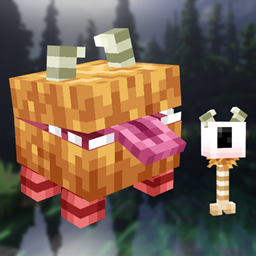
Living blocks are mobs meant to represent blocks, exclusive to 26w14a.
Spawning
Living blocks span most of the actions that previously generated an item entity, including:
- Breaking a block that generates loot
- Breaking a container block
- Dropping an item (with some exceptions)
- Killing an entity that drops loot or equipment
- Living blocks can also drop living blocks, see § Drop
- Other generations of loot tables
- When a falling block is dropped as an item
- When a lead breaks
Similar to the behavior of items entity to be destroyed, destroying a living block container, such as a shulker box, chest, or bundle, spawns the living blocks that items were inside. Some items from the living block container are also dropped as living block when attacking the living block container.
In some cases where items were generated in the inventory, they now generate living blocks. These are:
/givecommand- A player in Creative mode using pick block on a block
- But using pick block on an entity still generates an item in the inventory.
Converting
Living blocks are also generated by procedures that previously transformed items into new items when used in the inventory; now, living block behaviors generate new living blocks, such as:
- Crafting using a crafting grid
- Smelting a living block
- Filling a living bucket
Other conversions mimic block behaviors, which are:
- Living concrete powder, when in contact with water, transforms into living concrete
- Living sponge, when in contact with water, transforms into living wet sponge
Living iron bars can form living iron traps, and living copper bars can form living copper traps.
Monster spawners
Living End portal frame monster spawners naturally generate in End portal rooms in strongholds, replacing the silverfish spawner. Groups of up to 4 living End portal frame are spawned at a time until a total of 12 are reached near the spawner. More living End portal frame may be generated if the living End portal frames are moved away.
Drop
On death
Living blocks drop the result of a one-item recipe if the item associated with the living block is used. For example, a living oak log drops four living oak planks, since with exactly one oak log can craft four oak planks.
Living block containers also drop the items that are in their internal inventory.
Behavior
Living blocks stay still until commanded to do something. When commanded, they roll (if they are a block) or fly (if they are an item).
Replacing item entity
The item entity has been removed, and in many instances where it was previously used, living blocks is now used instead.
Drop
Previously, when an item dropped from the inventory, a container, etc., an item entity was created on the ground. Now the behavior is different and depends on the item in question:
- If it's an action item, nothing happens.
- If it's a spawn egg, the related mob is spawned.
- Technically, this behavior is defined by the component
minecraft:entity_data, for example:- The item
bat_spawn_egg[!minecraft:entity_data]is dropped as a living bat spawn egg item and not as a bat - The item
stone[minecraft:entity_data={id:bat}]is dropped as a bat and not as a living stone item
- The item
- Technically, this behavior is defined by the component
- Otherwise, it creates a living block.
- The number of living blocks created is equal to the number of items dropped.
- Each block is spawned next to the previous one in an random horizontal direction.
- If there is a collision at the initial spawn location, the block searches for a new spawn point in a 1x5x7 + 7x5x1 area. The initial position is at the bottom of this area at its horizontal center.
- First, the block checks along the Y-axis. If no positions are available, it then checks horizontally (randomly but prioritizes blocks closer to the original position).
- If it cannot find a valid position, it spawns at the original position regardless.
- If there is a collision at the initial spawn location, the block searches for a new spawn point in a 1x5x7 + 7x5x1 area. The initial position is at the bottom of this area at its horizontal center.
- If the item was dropped by a player, the living block considers that player as its owner and is selected.
Special properties
Some living blocks have special properties:
- Living wool floats upward. If more than three wool are following the player, the player gets reduced gravity, allowing them to jump higher and fall slower.
- Living anvils have a unique attack where they fly to the target, then turn into a regular falling block high above it aiming to fall on it and deal damage
- Living glass can take fall damage
- Living levers can be toggled, and also toggle themselves at random.
- Living beds can be slept in
- The player's view moves and even rotates with it
- The respawn point is set only by sleeping in it, interacting with it is not sufficient
- The respawn point does not move around with the bed
- Destroying the bed does not remove the respawn point
- Living furnaces, blast furnaces, smokers, and campfires smelt/cook nearby compatible living blocks automatically (no fuel needed)
- Living chests, barrels, and other containers pick up nearby living blocks, as long as the living blocks are not part of a group and other usual restrictions. They also do not respond to build commands.
- The contents can be opened by using on the container. Items are dropped out and converted to living blocks. Dispensers and droppers instead do their usual action. Punching or killing the living block also ejects their contents. Ender chests make enderman sounds when picking up blocks
Certain combinations of living blocks may combine into structures (made of regular blocks). The shape is not important, the necessary blocks just have to get close to each other.
- Any door may combine with 23 other blocks to combine into a small 3×3×3 house. The other blocks can be, for example, dirt, planks, logs, cobblestone (but not stone).
- The blocks that can be used in the house are controlled by the tag
#builds_into_house.
- The blocks that can be used in the house are controlled by the tag
- Bone meal can combine with saplings to make trees.
- This does not work with other plants, but most of these can be built to grow normally.
- When 12 living obsidian and a living flint and steel are near each other, they transform into a Nether portal
- This is despite the fact that a minimum of 10 obsidian is ordinarily required
- This also does not match with the generated portal having 14 obsidian, as the corners are filled in with obsidian
- The flint and steel is entirely consumed even though ordinarily it would have 64 uses before breaking
- Nether portals can still be constructed out of ordinary obsidian blocks and lit
- When living End portal frames and living eyes of ender get close to each other, they may combine.
- When at least 12 living End portal frames with eyes are near each other, they transform into an End portal (made of regular blocks).
- Golems and the wither can all be constructed out of the usual blocks.
- The wither skips its usual charge up.
- The copper chest created with a copper golem is a living block, not a regular one.
- 272 cobblestone, 16 glass, and 4 torches (or 4 copper torches or 4 soul torches) combine into a 9×6×9 structure with a single 2-block gap for an entrance, 4 glass skylights, and one torch on each wall.
- Similarly when 8 living iron bars are nearby, they may randomly turn into a living iron trap. 8 copper bars may likewise turn into a living copper trap.
- These kinds of living blocks relentlessly pursue the player, regardless of distance or even gamemode.
- When they make contact with the player, they create a 3×3×3 structure out of iron/copper bars that entirely encloses the player, except on the bottom. This can potentially destroy other (regular) blocks.
- Can still be commanded despite this apparently hostile behavior, but resume pursuit afterward.
- Consequently, they can be neutralized by commanding them to build, turning them into regular blocks.
- Doors always appear as the bottom half only, even when instructed to "build" converting back into regular blocks, except by the above process.
- Living light source blocks function as expected.
Interact with living blocks (using Punch, Craft, or Highlight) to use an item's normal use functionality, if it has any.
- Food can be eaten
- When a potion or milk bucket is consumed this way, the container disappears too.
- Eyes of ender can be thrown
- Ender pearls teleport the player somewhere random without being consumed
- Interacting with a living boat or minecart item turns it into a normal boat/minecart (only on rails for minecarts)
- Lava and water buckets (including buckets with mobs inside) place the appropriate liquid, ejecting an empty bucket off to the side
Some items do not activate in this way but activate randomly on their own:
- Flint and steel sets fire as it moves. Fire charges do likewise but are consumed.
- This can be used to access the Nether through lighting a portal made of regular blocks of obsidian without consuming the flint and steel
- Bows and crossbows shoot automatically when commanded to attack and provided with arrows nearby.
- Arrows try to move near bows and crossbows.
- Hoes randomly till nearby blocks
- Axes randomly strip nearby blocks
- Shovels randomly transform nearby blocks
Some items do not perform their intended function when interacting with them:
Other items also have special behavior:
- Living weapons do more attack damage matching their usual properties.
- Living tools can be used to mine.
- Living armor may equip itself to nearby compatible entities. After that, it functions completely normally.
- It does not replace any armor already present.
- Elytra cannot be equipped
- Chests cannot be equipped onto donkeys/mules/llamas
- Elytra launch any colliding living blocks upward
- TNT ignites as usual when set on fire or broken. It also ignites when killed, with a shorter than usual ignition time.
- Cows, pigs, and sheep are tempted by their usual food items in living form (controlled by block tags).
- Snow (not snow block) can be rolled around on non-living snow, absorbing the snow and growing taller each time it lays flat on the surface.
- Living buckets that enter water sources, lava sources, or powder snow fill with the appropriate contents, consuming the liquid/powder snow.
- Living concrete powder that enters water (source blocks only) converts into living concrete, consuming the water.
Sounds
Generic
 gravel sound type | ||||||||
|---|---|---|---|---|---|---|---|---|
| Sound | Closed captions | Source | Description | Identifier | Translation key | Volume | Pitch | Attenuation distance |
| Block broken | Blocks | Once the block has broken | block | subtitles | 1.0 | 0.8 | 16 | |
| Block placed[until: JE 26.4] | Blocks | When the block is placed | block | subtitles | 1.0 | 0.8 | 16 | |
| Block breaking | Blocks | While the block is in the process of being broken | block | subtitles | 0.25 | 0.5 | 16 | |
| Something falls on a block | Entity-Dependent | Falling on the block with fall damage | block | subtitles | 0.5 | 0.75 | 16 | |
| Footsteps | Entity-Dependent | Walking on the block | block | subtitles | 0.15 | 1.0 | 16 | |
Data values
Entity data
- [NBT Compound / JSON Object] Entity data
- Tags common to all entities see Template:Nbt inherit/entity/template
- [Int Array] owner: the UUID of the player owning the block (only if it is part of a group), if set then this is the only player that can command it
- [NBT Compound / JSON Object] item: the item or block the living block represents
- An item stack in a container slot see Template:Nbt inherit/item/template
- [Boolean] pinned: if true, this living block does not respond to commands and does not move except by gravity or knockback
- [Float] health: the health of the block
- [Int] despawn_ticks: initially 6000 (5 minutes). Counts down when no player is within 50 blocks. However, it is allowed to count down to negative values, and nothing happens.
- [Float] max_health: the maximum amount of health of the block
- [Int Array] commander: the UUID of the player commanding the block
- [Boolean] selected: true or false (1 or 0), if the block is being selected for an action
- [String] group: the name of the group, such as
red,blue,lime,yellow,purple, oraqua(defaults tonone) - [NBT Compound / JSON Object] container_behavior_data
- [NBT List / JSON Array] Items: the items in the container
- An item stack in a container slot see Template:Nbt inherit/item/template
- [NBT List / JSON Array] Items: the items in the container
Advancements
| Icon | Advancement | In-game description | Actual requirements (if different) |
|---|---|---|---|
  | Large Living Blocks Model | Automate your crafting with a Crafter | Have a living crafter in the world. |
Issues
Issues relating to "Living Block" are not maintained on the bug tracker because it is an April Fools' joke, and is therefore not in the newest stable version or snapshot. Issues reported there are closed as "Invalid".