
 Not to be confused with Ore (feature).

| Biomes | Any |
|---|---|
| Consists of |  Deepslate Iron Ore Deepslate Iron Ore
|


An ore vein is a rare underground terrain feature that provides massive amounts of ore. It has a chance to be either an iron or copper based vein. Depending on the ore it is, it will rarely spawn a few raw blocks of that ore.
Structure

Ore veins occur as large branching networks of a filler rock, paired with high concentrations of an associated ore type. Copper veins generate between Y=0 and Y=50 and contain copper ore and raw copper, with granite as the filler material. Iron veins generate below Y=-8 and can reach as deep as Y=-60, and contain iron ore and raw iron, with tuff as the filler material.
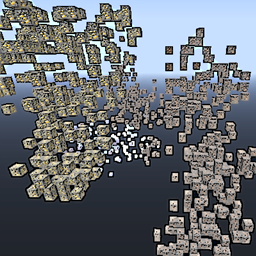
Ore veins generate similarly to spaghetti caves and share their shape and scale. They snake and branch, forming large networks and eventually reaching dead ends. Where they intersect caves, the player can easily spot them in the floors, walls, and ceilings. The size of a single vein is virtually unlimited; in some cases, more than 2,000 of a particular ore can be found in a single vein.
Ore veins are a part of cave generation and are not decorators. This means they are overridden by caves, mineshafts or other underground structures. This also means they can generate in The Void biome.
The tuff or granite around an ore vein can be replaced by gravel, but the main mineral blocks (iron ore and copper ore) remain. So there can be ore blocks completely surrounded by gravel.
Generation
Ore veins generate the same way as noise caves, in particular spaghetti caves. They are thickest between Y=20 and Y=30 for copper veins and between Y=-40 and Y=-28 for iron veins, and taper off towards the limits of their generation at Y=0 to Y=50 and Y=-60 to Y=-8 respectively. 70% of the blocks within the vein are not changed. Of the remaining 30% between 10% and 30% is the ore material within the vein, with the rest being filler material. 98% of the non-filler blocks generate as normal ore blocks, while 2% are generated as raw ore blocks (block of raw copper and block of raw iron, respectively).

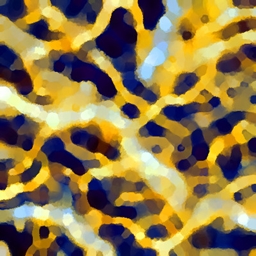
While the composition of veins is hardcoded, datapacks may change the shape and size of veins by changing the vein_toggle, vein_ridged and vein_gap density functions supplied to the noise router.
History
Development
| March 12, 2021 | Agnes Larsson talks about "New really big ore veins we are going to add". | ||||||
|---|---|---|---|---|---|---|---|
Java Edition
| Java Edition | |||||||
|---|---|---|---|---|---|---|---|
| 1.17 | 21w16a | Added ore veins, which must be enabled using the Caves & Cliffs Prototype Data Pack. | |||||
| April 21, 2021 | Henrik Kniberg showcases ore vein generation. | ||||||
| April 22, 2021 | Kniberg mentions tweaks to ore vein generation: the veins are now smaller and more clumped. | ||||||
| April 22, 2021 | Kniberg mentions tweaking generation to make the gaps between clumps smaller. | ||||||
| 21w17a | Ore veins are now slightly rarer, slightly smaller, more clumpy, and can rarely contain raw metal blocks. | ||||||
| 21w18a | Ore veins were once again made slightly rarer and slightly smaller on average. Their sizes now vary significantly, meaning players can still find huge ore veins like in previous snapshots as well as smaller ones. | ||||||
| Raw metal blocks now generate more frequently within ore veins. | |||||||
| 1.18 | Experimental Snapshot 1 | Ore veins can now be found in the base game, and no longer have to be enabled with a data pack. | |||||
| experimental snapshot 2 | Ore veins are now slightly larger and spawn more frequently. | ||||||
Bedrock Edition
| Bedrock Edition | |||||||
|---|---|---|---|---|---|---|---|
| 1.17.30 Experiment | beta 1.17.30.23 | Added ore veins behind the Caves and Cliffs experimental gameplay toggle. | |||||
| 1.17.40 Experiment | beta 1.17.40.20 | Ore veins are now slightly larger and spawn more frequently. | |||||
| 1.18.0 | beta 1.18.0.20 | Ore veins can now be found by default, and no longer have to be enabled with experimental gameplay toggle. | |||||
Issues
Issues relating to "Ore vein" are maintained on the bug tracker. Issues should be reported and viewed there.
Gallery
-
 Copper vein with a raw copper block.
 -
 A copper vein exposed on the seabed.
 -
 Exposed copper vein.
 -
 Exposed iron vein.
 -
 Copper ore vein found exposed of surface.
 -
 An iron vein.
 -
 A copper vein.
See also
- Tutorial:Mining