Seasonfall
Seasons for Minecraft servers. Players join with an unmodified game and watch the world change through the year.
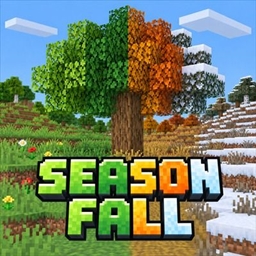
Seasonfall runs one continuous year: spring, summer, autumn and winter. Nothing flips over when a season starts; temperatures, colours, crop growth and day length all move smoothly through the year, and every biome responds according to its own climate. Plains swing strongly, jungles barely change, deserts cool down but stay dry, and snowy biomes stay frozen.
It is server-side: players don't need to install anything. Installing Seasonfall on a client is optional and only makes the colour changes show up live instead of the next time the player joins.
What changes
- Temperature: each biome follows a yearly temperature curve scaled to its climate.
- Snow: where winter makes a biome cold enough, rain falls as snow and settles, using the game's own weather. Nothing is placed when winter starts.
- Ice: still water freezes the way it does in snowy biomes, gradually from the edges in.
- Thaw: in spring, snow open to the sky melts a layer at a time and exposed ice turns back into water. Snow and ice under a roof are left alone.
- Leaves and grass: light yellow-green spring leaves, deep summer green, yellow-orange-brown autumn leaves over olive grass, and grey winter leaves and grass. Evergreen, tropical and dry biomes change much less. Players with the mod also see birch, spruce, cherry, azalea and pale oak leaves change (pale oak only exists on 26.x): cherry blossoms turn peach in autumn and a soft pink-grey in winter.
- Falling leaves: the leaves and petals drifting down from trees match the colour of the tree they fall from. On 1.21.1 and 1.20.1 only cherry trees drop petals.
- Crops: growth speeds up or slows down with the seasons, by crop type (most crops slow to 0.4x in winter; melons, pumpkins and other warm-season crops even more). Crops under a glass roof grow at least at normal speed all year.
- Day length: longer days in summer and longer nights in winter. A full day still takes the usual time.
- Weather: rain and thunderstorms become more or less frequent through the year.
There are no new items, blocks or screens, and no chat messages: players notice the seasons by the world changing around them.
Settings
Everything is in config/seasonfall.json, with a comment above every option:
- season length (24 days each by default), and which dimensions have seasons
- the season a new world starts in (random by default, picked from the world seed)
- whether the seasons wait while nobody is online (on by default; the server itself keeps running)
- the yearly temperature curve
- leaf and grass colours for every kind of biome, and how many colour steps the year has
- crop growth speeds by group, per crop (vanilla or modded) and per biome
- freezing, snow and the thaw temperature
- summer and winter day length
- per-biome changes for vanilla or modded biomes
Modded biomes get sensible seasons automatically from their own climate and tags.
Operators can use /seasonfall season, /seasonfall setseason, /seasonfall setday, /seasonfall pause, /seasonfall resume and /seasonfall reload.
Compatibility
- Minecraft: 26.3, 26.2, 1.21.1 and 1.20.1, each with its own file. Pale oak and leaf litter only exist from 1.21.4, so the older files don't change them.
- Fabric: requires Fabric API.
- NeoForge: no other mods needed. On 1.20.1 this is NeoForge 47.1, which is still a fork of Forge.
- Forge: no other mods needed.
- Terralith: works out of the box. Its biomes get seasons from their own climate, and its Skylands islands, each already themed after one season, keep their look all year.
- Elapsed: crops left unloaded catch up by the seasons they actually spent unloaded (Minecraft 26.x).
- Stormcell: Seasonfall shares the season's climate with the Stormcell weather mod instead of changing vanilla weather.
Source code and issue tracker: github.com/Romoslayer/Seasonfall