Animals drop layers on their own daily schedule, players carry a server-tracked digestive tract, villagers use the privy if the village built one, bats pay their way in guano, and the poop rots down into fertiliser. It is a nutrient cycle with a punchline, and the punchline is load-bearing: the reason to shovel the street is that the shovelling is worth something.
A snow-layer-alike block (1-8 layers) that stacks as poop accumulates. The first two layers render as chunky piles rather than flat sheets, and a third packs them down into a sheet no taller. That is all a loose heap takes: a fourth deposit slides to one of the eight tiles around it instead, so a busy spot spreads into a wide field rather than growing a tower. Only once every tile it could roll to is at three does the patch climb, a layer at a time on whichever pile is lowest, so it thickens as a mat. Natural accumulation stops at the full 8 layers, and where the pile is held in, by walls on all four sides (a latrine pit, a fenced corner, a hole you dug) or a poop block underneath, the ninth deposit packs it into a poop block: nine poop to a block, the same nine it crafts from. Shovel is the right tool; mining drops one poop item per layer.
Nothing you can trip over. A pile has no collision at any depth, so a herd cannot wall itself into a corner of its own pen, and a path through a field stays a path.
Bigger animals leave more, and sooner. How much and how often comes from the space the animal takes up - width squared by height, vanilla's own reckoning, and the same test farmland already uses to decide who is heavy enough to trample it. A rabbit is 0.08 and waits twice as long as usual; a cow is 1.1 and sets the pace; a horse is 3.1 and comes round a little sooner; a camel is 6.9 and leaves two layers when it goes. No table of entity ids to maintain, so a modded moose sorts itself.
A loose pile of one to three layers draws a few near-black specks zig-zagging over it in short darting legs, close up and during daylight hours only. Put any block on top, or stack it past three layers, and they stop. They are ordinary particles sent by the server, so vanilla clients see them too; guano attracts none, and caves stay quiet.
With block-tip installed, a pile of one to three layers names what left it and how cold the trail has gone: Cow, fresh, north, then warm, then soft, then just Old. A hundred seconds a band, so a pile that still talks is a quarter of a day old at most. The kind only, never the individual. The heading is the way it was facing as it went and only the first two bands carry it: cold sign keeps its maker, not its direction. A pile two different animals have been at reads Old at any age. A stack taller than a loose heap says nothing at all: it is a heap somebody built, not a trail somebody left, so the piles that talk are exactly the wild ones out in the street and a latrine keeps its users anonymous. None of it is written to disk: a restart forgets every trail.
Every animal poops at least once per Minecraft day, on its own randomly-seeded schedule (no dawn chorus), with a suitably undignified sound. Water animals (fish, squid, dolphins) do it too, in the water, as fish do: a brown cloud that disperses in the current instead of a layer, which also applies to anyone or anything pooping while swimming.
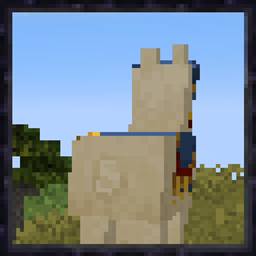
Llamas. llamas and trader llamas walk to the nearest existing poop pile within ~16 blocks and go there, founding a communal spot in place when none exists. A llama that can't reach the spot in time has an accident where it stands.
Shovel is the right tool. Mining a stack by hand forces the decay instead, so the growth still happens and the items do not.
Pooper Scooper is a shovel enchantment of three levels, ordinary enough to turn up in an enchanting table, on a villager's trades, or in loot. Each level finds one more poop or guano in a pile than was strictly in it, so a full stack under a level III shovel comes up three richer. Somebody has to want this job.
An animal standing in a crop when it goes leaves no pile: the crop gets a bonemeal's growth on the spot, and a big animal's double helping feeds the plants round it too, so a pen fenced over a field grows the field. Layers rot away on random ticks, a layer at a time, taking about half a Minecraft day each. A rotting layer feeds the ground below it - or the crops planted alongside, with the green particle burst - roughly one time in four. Breaking any poop or guano block without a shovel forces the decay instead of dropping anything: one growth charge per layer, nine for a full block.
A pile that keeps being added to keeps living. Decay is per layer, so every fresh deposit buys the heap another layer's worth of time. Somewhere a herd stands all day gains faster than it rots and needs shovelling; ground the animals only cross now and then clears itself. Room is the other answer to muck, and the cheaper one.
A poop dropped over an edge falls as far as there is world to fall through, with a descending whistle for exactly as long as the fall and then the landing: a splat on ground, a sploosh into water, a sizzle into lava. The splat's echo back up to you gets fainter the longer the drop, because a hundred blocks down is barely audible, and that distance is the joke. A hundred-block drop earns the Off a Cliff advancement.
The poop item throws like a snowball. Hitting a player inflicts brief nausea and slowness. Landing on the ground fertilises where it lands, one layer's worth, so a thrown handful is muck arriving all at once rather than only a prank.
Poop block. Nine poop items, three by three, craft a full block - the eight layers a heap stacks to and the one that caps it - which mines back into itself and crafts back into nine.
Composting. both the poop item (moderate chance) and poop block (high chance) feed the composter.
Food goes to the stomach, which is the vanilla hunger bar, and becomes waste as that drains: every hunger point spent adds 3 to a persistent 0-100 bar. Raw meat, rotten flesh, and suspicious foods add a hefty 25 on the spot, with a ~30% diarrhea risk. Diarrhea fills the bar rapidly for ~90 seconds under Hunger + Nausea, and persists through relogging. The bar renders as a digestive tract that takes over the vanilla hunger bar's exact rectangle and no more: a stomach at the left filling with amber as you eat, its outlet feeding a pink intestine that squiggles rightward and fills with brown as you don't poop, and a sphincter at the end that a poop icon briefly pops out of when you do. Clients whose Pandorical build can suppress vanilla HUD elements get it in place of the drumsticks; older ones keep the drumsticks and get the tract one row higher. Poop voluntarily with a keybind (default G, rebindable in the controls screen under the Pandorical category, bar >= 20) or involuntarily at 100. Either way: a layer at your feet, a fart, a hunger point, and a reset bar. Sneak while pooping to aim it one block behind you, dropping into whatever is down there, which is exactly how you use a latrine pit with dignity. Aimed at a crop it is manure instead: the plant gets a bonemeal's growth and no pile is ever left in the row (a crop grown out just wastes it), and a double deuce (bar at 80 or more) feeds the plants round it as well. Anywhere else a double deuce is two layers, and aimed behind you both go behind you. Also: your first ever step into the Nether carries a 50% chance of an immediate accident, rolled exactly once per player, regardless of how empty you thought you were.
The bar is per player and survives a relog. It does not survive a death: you come back empty, which is the one mercy in the whole system.
Going to sleep on a nearly full intestine is a roll of the dice: nothing at 70 or under, ramping to about 1 in 3 just short of full. A full bar or the runs is no roll at all: it happens. It lands a couple of seconds into the sleep screen, close enough to hear, as a pile on the bed, sitting on the mattress, which a shovel takes off again. The bar empties and the hunger point is spent as if you had gone properly, and you wake to a quiet "Not again". The bed itself is left alone.
Villagers poop too: roughly once per day, never at night and never mid-sleep. Where they go depends on the plumbing:
Bats finally earn their keep. Every bat drops guano roughly once per day on its own schedule, and the guano falls from the roost: it lands as a pale grey layer on the first surface below, cave floors included. Guano layers stack like poop layers but never rot: a roost builds a bed of it where it falls, eight layers deep and then packed into guano blocks, open cave floor or not, for somebody to come and quarry. A shovel harvests one guano per layer, and breaking guano without one forces the growth out of it the way it does for poop.
Poopsmith runs server-side, and Pandorical is a hard dependency: it carries every client-facing piece. Block, item and asset sync (the textures ship in this jar; Pandorical's virtual resource pack delivers them), the thrown-poop renderer, the digestive HUD including its takeover of vanilla's hunger bar, the poopsmith's gloves overlay, and the poop keybind, which is a pooled Pandorical keybind so no poopsmith jar ever reaches a client.
Clients are the optional half. A player on a Pandorical client gets the bar and the keybind; a player on a vanilla client participates fully server-side but cannot see the bar or go voluntarily. Accidents happen.