Badges update automatically and link to the mod page on MineUniverse.


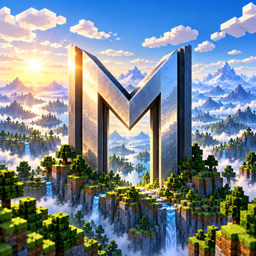
Metalith shows the world far beyond your render distance on Apple Silicon Macs. Minecraft and Sodium keep drawing the terrain around you; Metalith fills in everything past it with lightweight distant terrain, out to 4,096 chunks if you want.
A horizon, not a wall of fog. Pick any distance from 32 to 4,096 chunks (256 by default). Near terrain stays exactly as the game draws it; distant terrain appears only where Minecraft draws nothing, so nothing ever pokes through your blocks.
Drawn with Metal. Without a shader pack, the far terrain is rendered by Apple's Metal straight into the game's frame. On an M3 Max at 2048×1152 with a 256-chunk radius that is 170–280 FPS depending on the view, and the mod's own work on the render thread is well under a millisecond per frame.
Shader packs shade it too. With Vitrail installed, your shader pack lights the distant terrain the same way it lights the near world: its own fog, water, cloud shadows and shadow map, through the same dh_terrain programs it already has for Distant Horizons. Tested with Complementary Reimagined.
Real terrain, generated from your seed. The horizon fills within a couple of seconds from the world generator's noise. Then, in the background, Metalith generates the actual terrain from the seed, in memory: the right surface blocks, trees with trunks, lakes, snow, cave mouths. Chunks you have already explored always take precedence and carry your buildings. Nothing is ever written to your world.
Looks right from afar. Hillsides show layers of dirt and stone instead of flat green. Forests are canopies over dark trunks, snowy spruces get white tops, and vines, flowers and bamboo tint what they grow on. Colours come from your resource pack, and switching packs recolours the far terrain in place. The Nether (without its roof) and the End (as floating islands) have their own distant terrain; beacon beams reach into it; block changes update it.
Detail where you look. By default a distant cell is at most one pixel on screen. Terrain in front of the camera is refined first, and whatever a hill hides is not drawn at all.
Smooth. Generation and meshing run on worker threads, and the default "Smooth" generation speed backs off whenever Java's garbage collector starts to stutter. Everything is cached on disk (about 80 MB for a 256-chunk radius), so coming back to a world restores the full view in a few seconds.
Multiplayer. On a server that runs Metalith (the same jar on a Fabric server), players receive the distant terrain from the server, including places they have never been. On a server without it, Metalith keeps what your client has seen, per server and world, so the far view builds up over your sessions. Nothing is sent anywhere.
Settings in the game. A button next to the FOV slider (Esc → Options) opens them: distance, quality, a separate far-detail preset for shader packs, GPU memory budget (up to 16 GB), generation speed and threads, fog, horizon culling, a cache-clear button and F3 overlays. English and Russian.
Inspired by the ideas behind Distant Horizons and Voxy; no code from either is used. Shader-pack support is possible thanks to Vitrail. MIT licensed.