Credit to TheWiggleDuck for the awesome Curseforge project icon!
MCA: Conversations expands the dialogue and social systems of Minecraft Comes Alive: Reborn, giving villagers more to say, more ways to respond, and more reasons to remember the conversations you have with them.
You can check out example datapacks here to better understand how customization works: Click Here to Visit on GitHub
Instead of treating conversation as a menu of repeatable buttons, Conversations turns villagers into more persistent characters. They develop individual interests and values, remember previous discussions, react to how you answer them, talk about events happening around their village, and can carry conversations across multiple encounters.
The goal is not to replace MCA Reborn's relationship system. Hearts remain MCA's authoritative relationship value. Conversations builds around it with additional context, memory, personality, and dialogue.
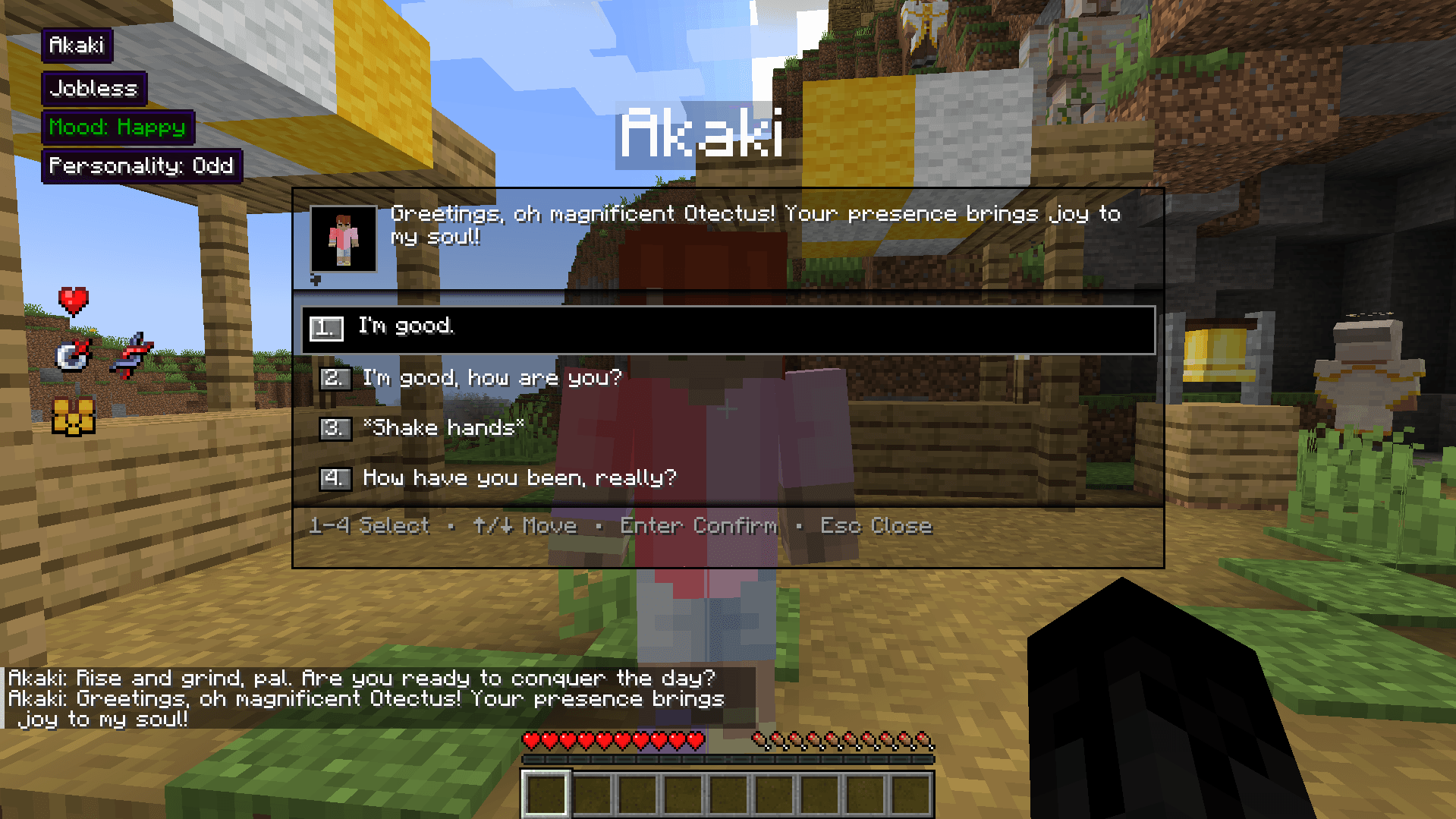
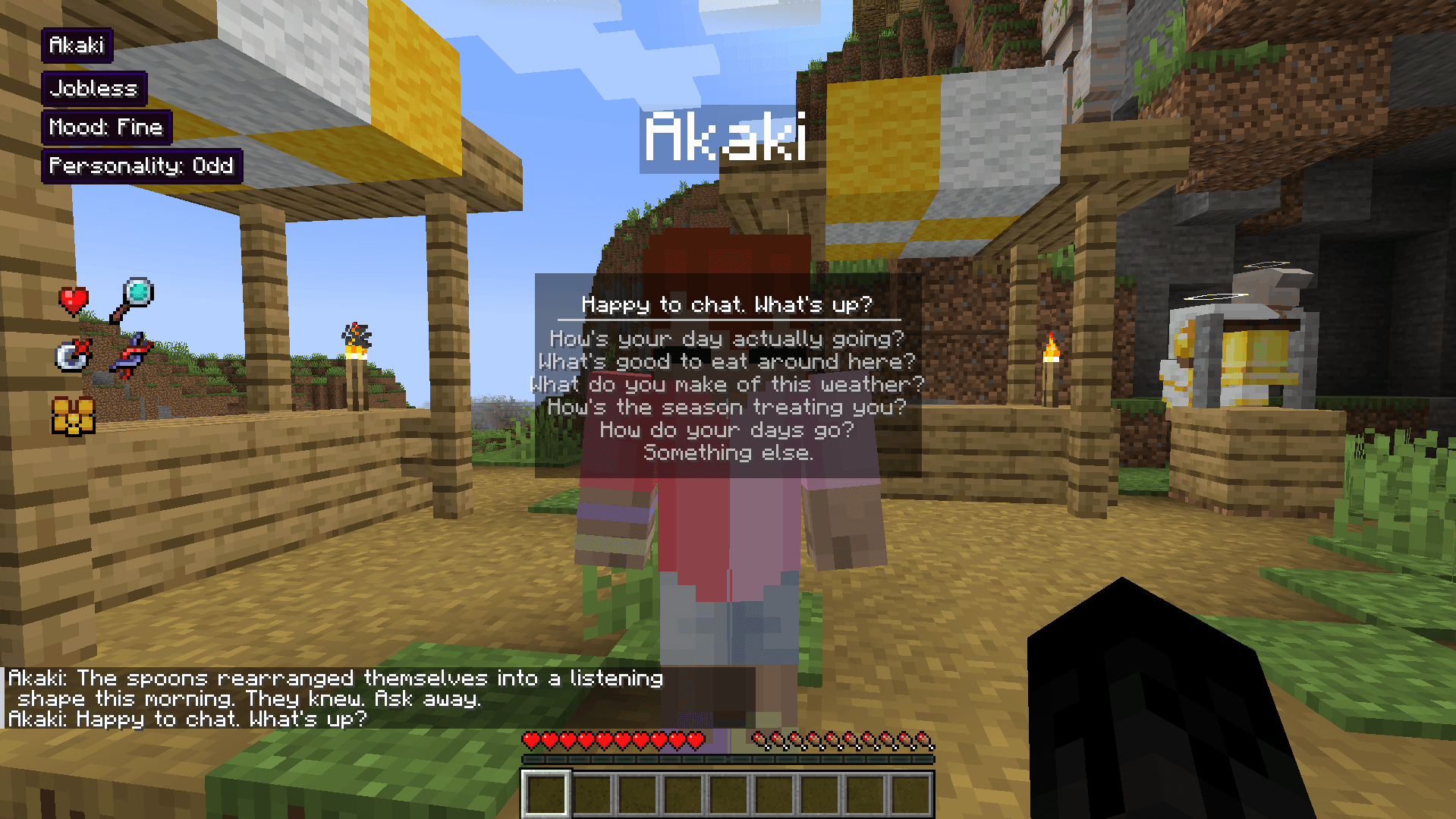
MCA's Chat interaction is expanded into a larger conversation hub covering topics such as:
Available topics depend on the villager and your relationship with them. Children and adults do not speak identically, professions influence relevant conversations, and relationship-specific topics only appear when they make sense.
Many topics are full conversations rather than single dialogue lines.
A villager might tell you about a bad day, disagreement or personal concern, then let you decide how to respond. Supporting them, dismissing them, disagreeing with them, apologizing or pushing further can all lead somewhere different.
Importantly, simply asking a question does not automatically reward hearts. What matters is how you respond.
Some deeper responses also use deterministic dialogue checks influenced by your relationship, the villager's mood and other context. These can result in stronger successes, partial successes or in-character rebuffs.
Conversations can persist beyond the screen you currently have open.
Villagers can remember:
Closing and reopening the conversation does not simply reroll everything into a different result.
Two villagers with the same profession are no longer treated as interchangeable copies of one another.
Each villager receives stable personal characteristics generated from the world and their identity, including interests, values, comforts, aversions and tendencies in how they work, socialize and open up to other people.
These characteristics remain consistent across restarts and between players.
MCA personalities also influence how dialogue is worded. A crabby villager, an anxious villager and a peppy villager can approach the same subject very differently.
MCA hearts remain the visible relationship value, but Conversations also tracks additional private context such as:
These values do not replace hearts or directly grant them. They help determine how villagers respond, what they are comfortable discussing and how certain conversations resolve.
Villagers can occasionally bring something up themselves instead of waiting for the player to choose a topic.
They may remind you about:
This system is deliberately limited. Villagers will not constantly interrupt you, and they will not initiate conversations while sleeping, fighting, panicking or already occupied with another player. Players can also tell individual villagers to stop talking to them.
Villager initiative can be configured or disabled entirely.
Villages can develop persistent details of their own, such as traditions, values, landmarks, festivals, shared concerns and ongoing disagreements.
Villagers can also learn about events and pass information to one another. Information loses confidence as it travels, and personal information does not automatically become public knowledge.
News can include things such as:
Villagers do not necessarily agree with each other about what happens around them.
When a conversation lets you promise something, the game only offers that promise when there is a real way to observe whether you fulfilled it.
For example, a promised delivery can be completed when the requested gift is actually given to the villager.
Promises can be remembered, fulfilled, missed or brought up again later. The system avoids pretending that you completed something the game had no way to detect.
Conversations can also let you talk to MCA villagers through Minecraft's normal chat box.
For example:
Hey Coralia! How was your day?The mod attempts to understand the topic and routes it through the same dialogue system used by the normal interaction screen.
This is not AI or an LLM. Chat matching is deterministic and datapack-driven, using authored keywords, phrases, synonyms, typo tolerance and other matching rules.
You can address a villager by name, talk to the villager you are looking at, or continue speaking to your current conversation partner.
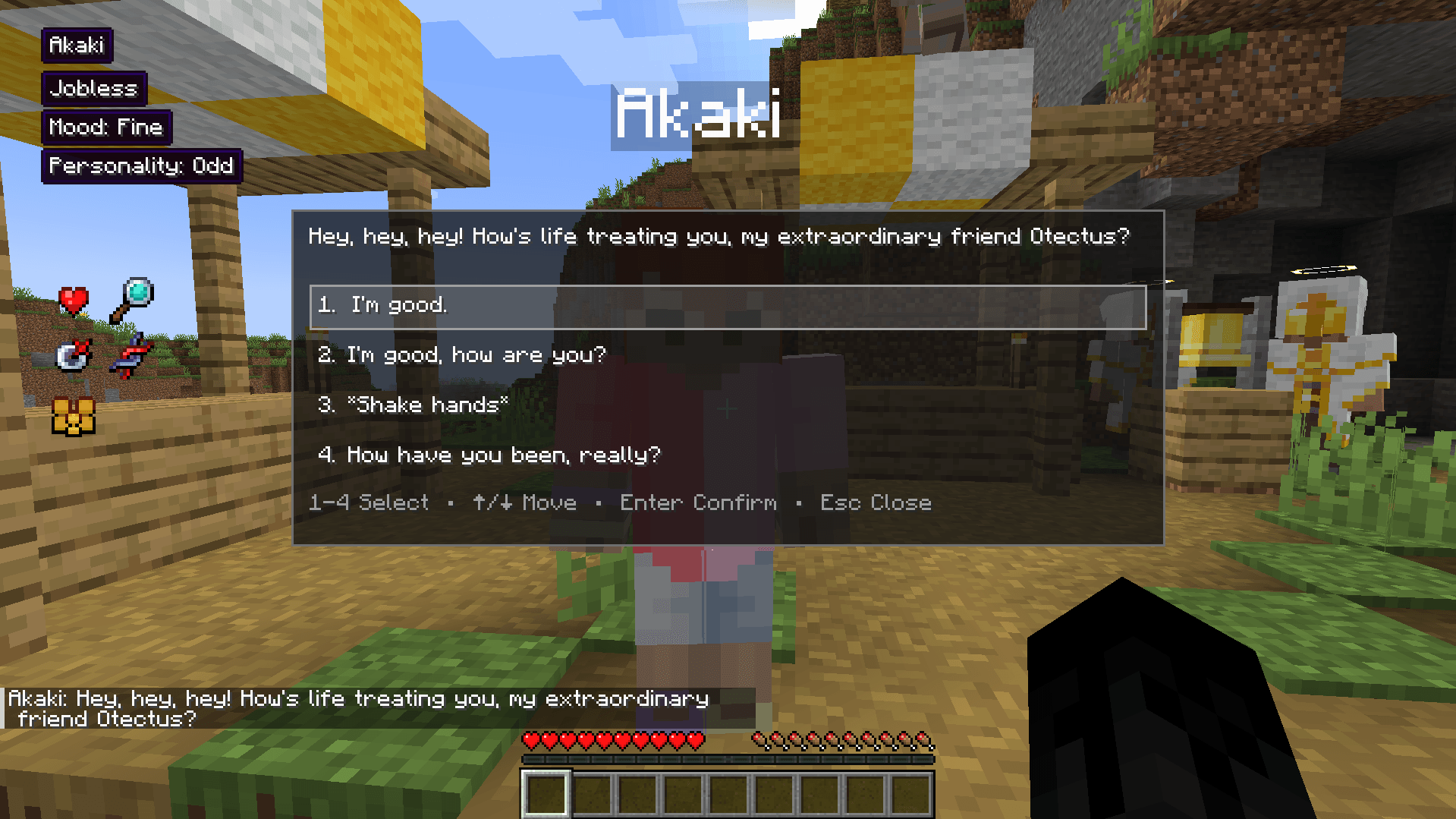
When the villager asks you to make a choice, numbered replies are also available if you would rather select an option than type a response yourself.
Chat mode can be configured or disabled.
The standard MCA interaction screen receives a responsive conversation card designed around Minecraft's own interface style.
Features include:
The interface uses Minecraft's own GUI textures rather than a custom visual theme. Resource packs that reskin vanilla menus can therefore affect the Conversations interface naturally.
The UI also adapts to smaller screens and custom fonts rather than assuming a fixed menu size.
Work conversations use the villager's actual profession wherever possible.
The mod includes specialized dialogue for vanilla professions as well as professions from a number of popular mods, including:
Unknown modded professions still receive generic profession-aware dialogue rather than simply failing to participate.
MCA: Conversations works without any of the following mods, but provides additional context when they are installed.
Adds quest-aware dialogue and lets conversations respond to relevant quest activity.
Supported as an optional dependency from MCA: Quests 0.8+.
Villagers can react to your public reputation and discuss deeds or incidents known around the village.
Supported as an optional dependency from MCA: Reputation 0.2+.
Conversations can use Townstead information such as village culture, schedules, buildings and other settlement context while preserving Townstead's own RPG dialogue interface.
Supported versions: Townstead 0.7.5 to below 0.8.
Season-sensitive dialogue uses the actual Serene Seasons season when the mod is installed.
Without Serene Seasons, Conversations falls back to its own calendar-based seasonal context.
MCA: Conversations is extensively configurable.
Configuration is separated by purpose:
Server and pack authors can control systems such as dialogue features, dispositions, gossip, chat behavior, hearing distances, heart rewards, conversation limits, villager initiative and history retention.
Players can independently configure presentation options such as numbered responses, keyboard shortcuts, portraits, text reveal, interface movement and sound volume.
A large portion of MCA: Conversations is data-driven.
Pack authors can add or modify conversations using datapacks, including their own:
The mod builds on MCA Reborn's existing dialogue system rather than replacing it with a completely separate engine.
See the repository's DATAPACK.md for the complete authoring reference.
Currently complete:
en_us)pt_br)This includes the main dialogue pool, interface text, personality variations, age-specific voices and chat-mode vocabulary.
[7.6,8)MCA: Conversations must be installed alongside Minecraft Comes Alive: Reborn.
For multiplayer, install the mod on both the server and connecting clients.
The current build is developed against MCA Reborn 7.7.0-beta.2 and maintains compatibility with the supported MCA 7.6 and 7.7 range.
Do not use MCA Reborn 7.7.0-beta.1. That MCA release contains its own broken production mixin metadata and fails independently of Conversations. Use 7.7.0-beta.2 or a newer compatible MCA release instead.
Architectury is not directly required by MCA: Conversations. Older MCA releases that require Architectury declare that dependency themselves.
MCA: Conversations is designed to remain useful in both lightweight MCA setups and larger RPG or village-focused packs.
Optional integrations fail gracefully when their corresponding mods are absent, and most conversation content can be extended through datapacks without modifying the mod itself.
If you want MCA villagers to feel less like menus and more like persistent people who remember what has happened between you, MCA: Conversations is built for exactly that.