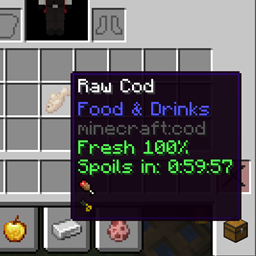
You harvest your crops, cook your meals, and stockpile provisions for the journey ahead. Days later, deep underground, you pull out that beef stew and find it just as fresh as the day you made it. A little strange, isn't it? In reality, food spoils. Why shouldn't it in Minecraft?
Freshness addresses this by giving every food item a shelf life. Fresh foods provide full nutrition. Over time, they become stale, offering reduced hunger and saturation. Left longer, they spoil—minimal nutrition with a side of nausea. Eventually, they rot entirely, transforming into rotten flesh or bone meal.
Spoilage is not a simple timer. Environment plays a role. The Nether doubles decay speed. The End slows it. Rain and water accelerate spoilage. Items dropped on the ground decay faster than those kept in inventory. These factors are displayed directly in the tooltip so you always know what's affecting your food.
Cooking serves a dual purpose: producing better meals and recovering freshness from aging ingredients. The formula takes the average freshness of all inputs, then restores half of what was lost.
Example: 50% cabbage + 100% carrot → average 75%. Half the 25% loss is 12.5%. Result: 87.5% freshness.
This mechanic applies across all supported cooking stations—Farmer's Delight cooking pot and skillet, campfires and furnaces, Kaleidoscope Cookery wok, steamer, stockpot, and shawarma spit. The cutting board transfers decay without recovery (chopping does not restore freshness).
Freshness integrates natively with Farmer's Delight and Kaleidoscope Cookery. All food items from these mods include pre-configured spoilage data. Every cooking station participates in the freshness system. Ingredients left in these stations also decay over time.
config/freshness/container_multipliers.json.config/freshness/ with sensible defaults.This mod was built out of a desire for more realistic food mechanics. Bug reports and suggestions are welcome.
Known Issues
Moving food items in Creative Mode resets their freshness