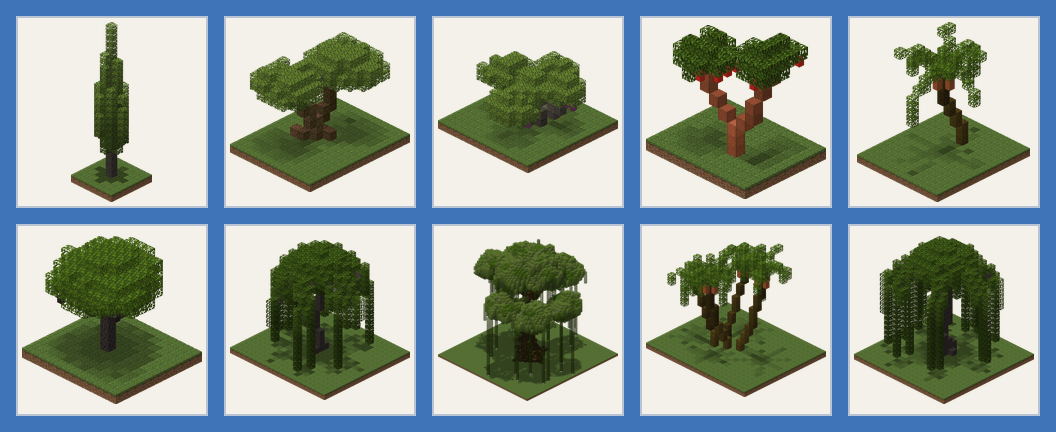
Nine Mediterranean trees for Minecraft 26.2 (Fabric), each grown from its own new sapling, six of them with fruit: Cypress, Olive Tree, Fig Tree, Strawberry Tree, Cretan Date Palm, Mulberry Tree, Weeping Willow, the large palm and willow that four saplings grow, and the giant Aries Oak. The trees themselves are built from vanilla blocks only (wood blocks with bark on every face, so no log ends show), and every growth rolls a new shape. Everything is in its own creative tab, Greek Trees; the saplings, fruit and pits also appear in the vanilla tabs.

Get greektrees-<version>.jar from CurseForge or the
GitHub releases and put it into mods/ on the client and the server, next to Fabric API. Requires
Minecraft 26.2, Fabric Loader 0.19.3+ and Java 25.
Every player gets a Greek Trees Guide the first time they join: a book with a chapter for every tree (what it looks like, its recipe, how to plant it, its fruit) and for the large trees, fruit and olive pits, with a picture of every tree, in English and German. Right-click opens it; the trees' tabs are on the left, the topics' on the right. Lost it? Craft a new one from a book and any of the mod's saplings (shapeless), or take it from the creative tab.
This page follows the book chapter by chapter and adds the details that do not fit on its pages.
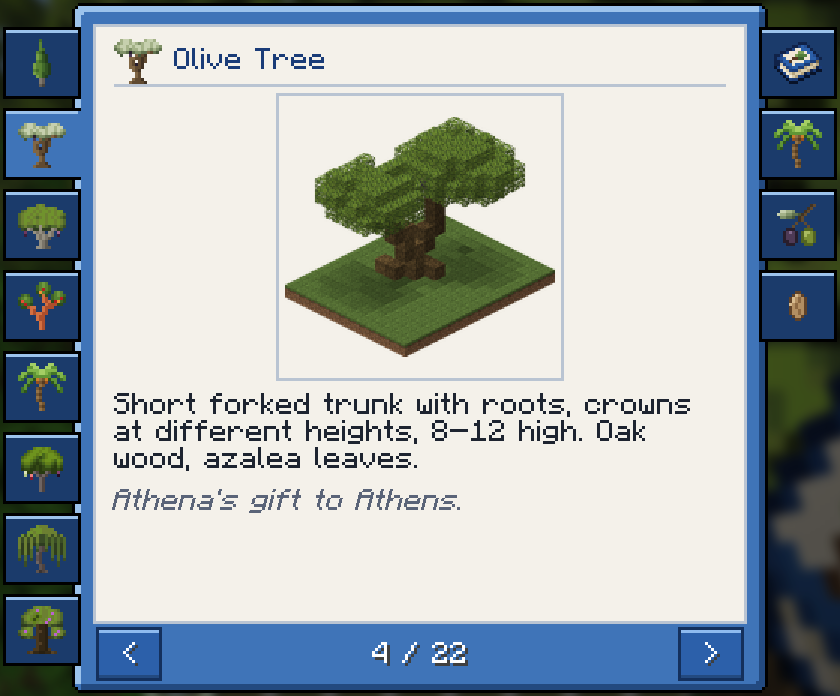
Every tree grows from its own sapling and is built from vanilla blocks; no two grow alike.
The shapes come from the concept work in concept/ (the cypress rules were measured on hand-built cypresses); the
dice ranges of every tree are listed in VARIATIONEN.md (German).
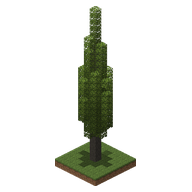
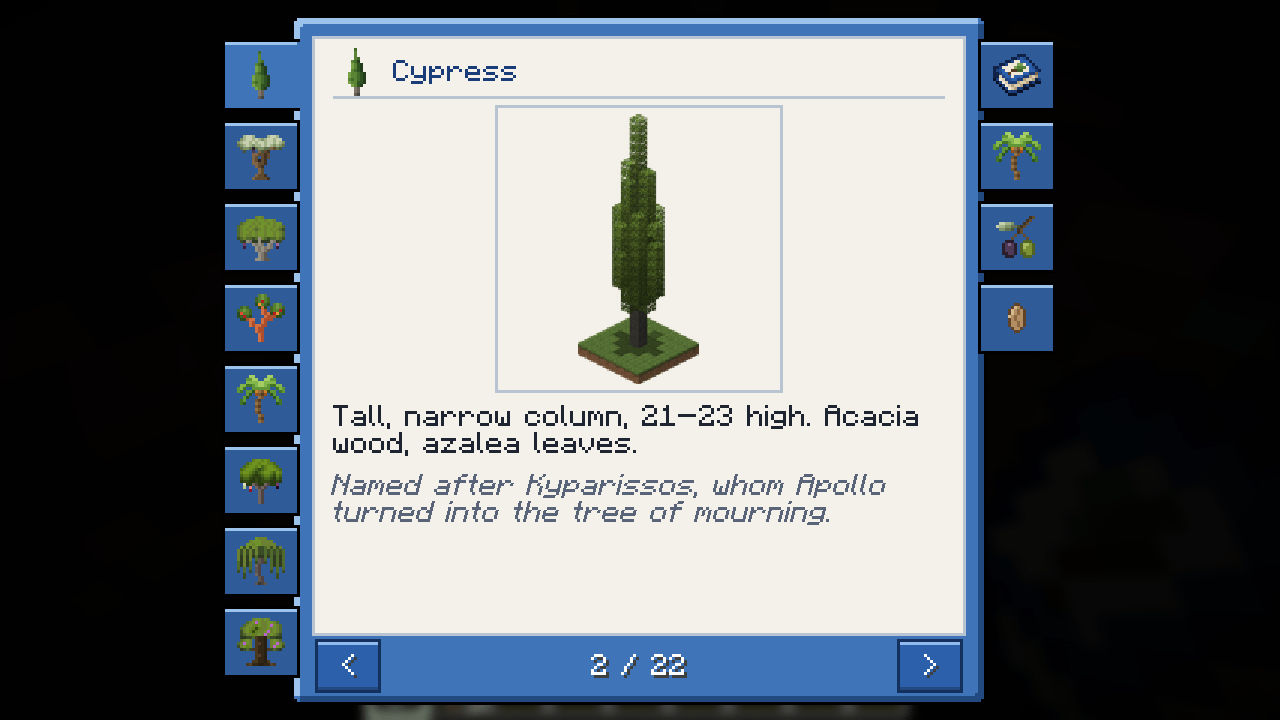
Tall, narrow column with a single-block spire, 21–23 high. Acacia wood, azalea leaves.
Named after Kyparissos, whom Apollo turned into the tree of mourning.
Crafting – spruce sapling, acacia sapling.
Planting – on dirt or grass. Grows with light or bone meal.
Fruit – bears no fruit.
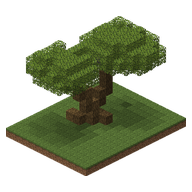
Short forked trunk with roots on the ground, crowns at different heights, 8–12 high. Oak wood, azalea leaves.
Athena's gift to Athens.
Crafting – oak sapling, azalea leaves, apple.
Planting – on dirt or grass. Grows with light or bone meal.
Fruit – olives on twigs under the leaves. 2 hunger, good saturation; eating one leaves an Olive Pit.
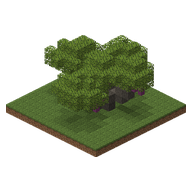
Low and wide, several stems from the ground, 7 high. Acacia wood, azalea leaves.
Figs fed the first athletes of Olympia.
Crafting – 2 acacia saplings, sweet berries.
Planting – on dirt or grass. Grows with light or bone meal.
Fruit – figs on twigs under the leaves. 3 hunger, good saturation.
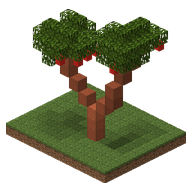
Thin orange-red stems, open dark crown, 10–11 high. Stripped acacia wood, mangrove leaves.
Its berries take a year to ripen, so flowers and fruit hang side by side.
Crafting – acacia sapling, sweet berries.
Planting – on dirt or grass. Grows with light or bone meal.
Fruit – arbutus berries on twigs under the leaves. 3 hunger.
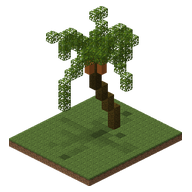
One to three slim trunks within a 2x2 square (two on a diagonal, three in an L), each leaning to its own side only, bent near the crown, bent at the foot or slanted, no two alike, 15–18 high. On every trunk a star of fine fronds under a tuft of steep ones, smaller on the lower trunks, every frond with its own direction, length and arch. Jungle wood, jungle leaves.
The Cretan date palm, named after Theophrastus, grows wild on the beach of Vai.
Crafting – jungle sapling, cocoa beans.
Planting – on dirt, grass or sand. Four in a square grow a large palm.
Fruit – dates in clusters on the trunk, right under the crown. 3 hunger.
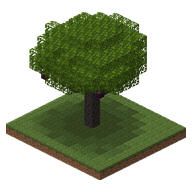
Short thick trunk forking low under a dense round dome, 10–11 high; three in ten are pollarded (knobbly fist, flat umbrella). Pale oak wood, jungle leaves.
Once white, the berries turned dark with the blood of Pyramus.
Crafting – pale oak sapling, sweet berries.
Planting – on dirt or grass. Grows with light or bone meal.
Fruit – black, white or red mulberries on twigs under the leaves, one kind per tree. 2 hunger.
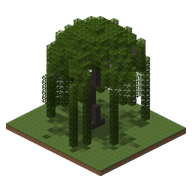
A trunk with a soft bend (along an axis or over a corner; now and then out and back like a C), limbs arching out and down under a rounded crown over the trunk's top, a curtain of single leaf strands with a room inside, a few vines, 11–21 high. Pale oak wood, mangrove leaves, vines.
Orpheus carried a willow branch into the underworld.
Crafting – pale oak sapling, azalea.
Planting – on dirt or grass. Grows with light or bone meal. Four in a square grow a big willow.
Fruit – bears no fruit.
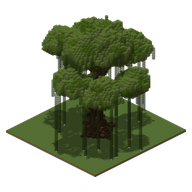
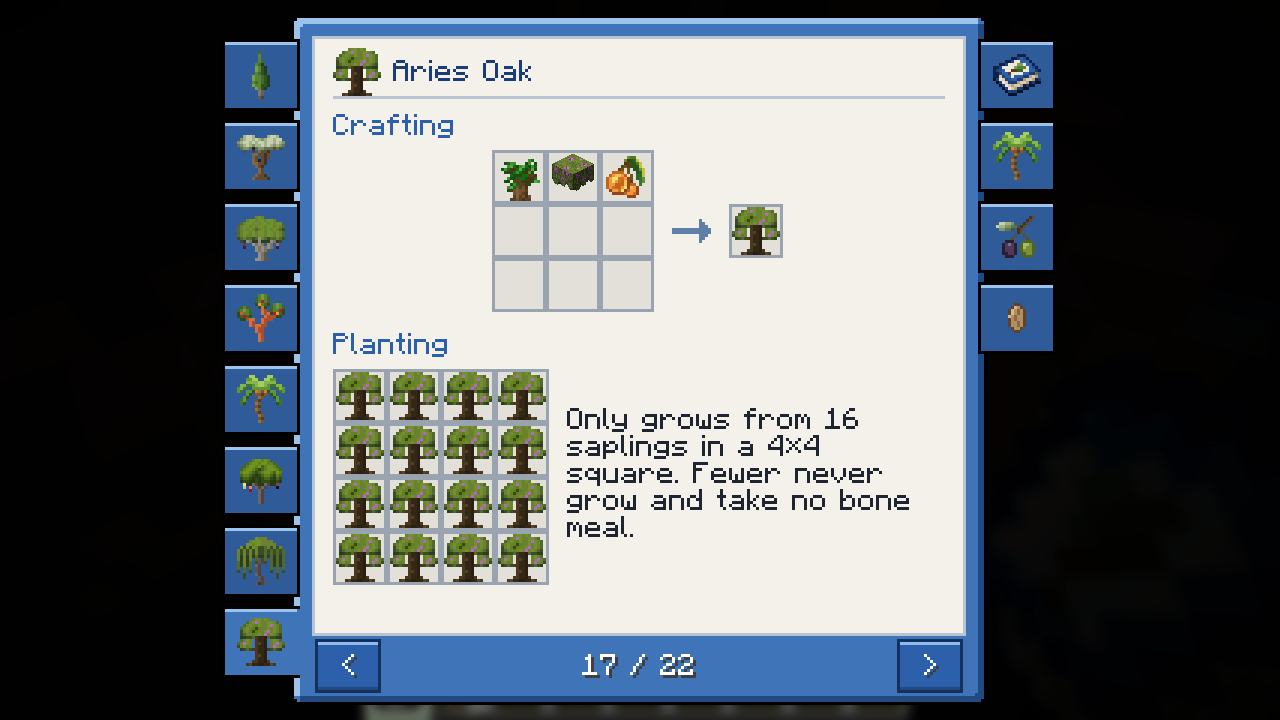
A giant, 53–60 high and about 50–58 wide, with hollow crowns to build in: a round trunk, wide and flared at the foot and narrowing upwards, with ridges, burls and stubs, slabs evening out the steps of its limbs and, fewer, of the trunk, and streaks of stripped bark; five to seven limbs with side branches, each carrying a big hollow side crown spanned by twigs that reaches out past a hollow main dome. Dome and side crowns are clean shells of leaves (and moss, on the dome) two blocks thick, lumpy on the outside; vines, glow berries and firefly bushes. Its leaves never decay. Dark oak wood, stripped dark oak wood, dark oak slabs, azalea, flowering azalea and jungle leaves.
Like the oak of Dodona, in whose leaves Zeus was heard.
Dedicated to SassyAries00, who built the tree it is modelled on.
Crafting – dark oak sapling, flowering azalea, glow berries.
Planting – only grows from 16 saplings in a 4×4 square (any of the sixteen starts it). A single one or a smaller group stays a sapling and takes no bone meal.
Fruit – bears no fruit.
Like a vanilla dark oak, four date palm or four weeping willow saplings in a square grow into one big tree.
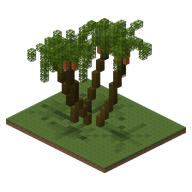 |
Large Date Palm – two to five tall trunks slanting apart, 19–27 high. |
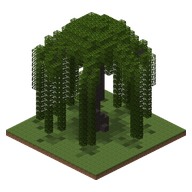 |
Big Weeping Willow – a 2×2 trunk bending the same way as the small one, its steps spread over a few layers, and more strands along the rim, 15–25 high. |
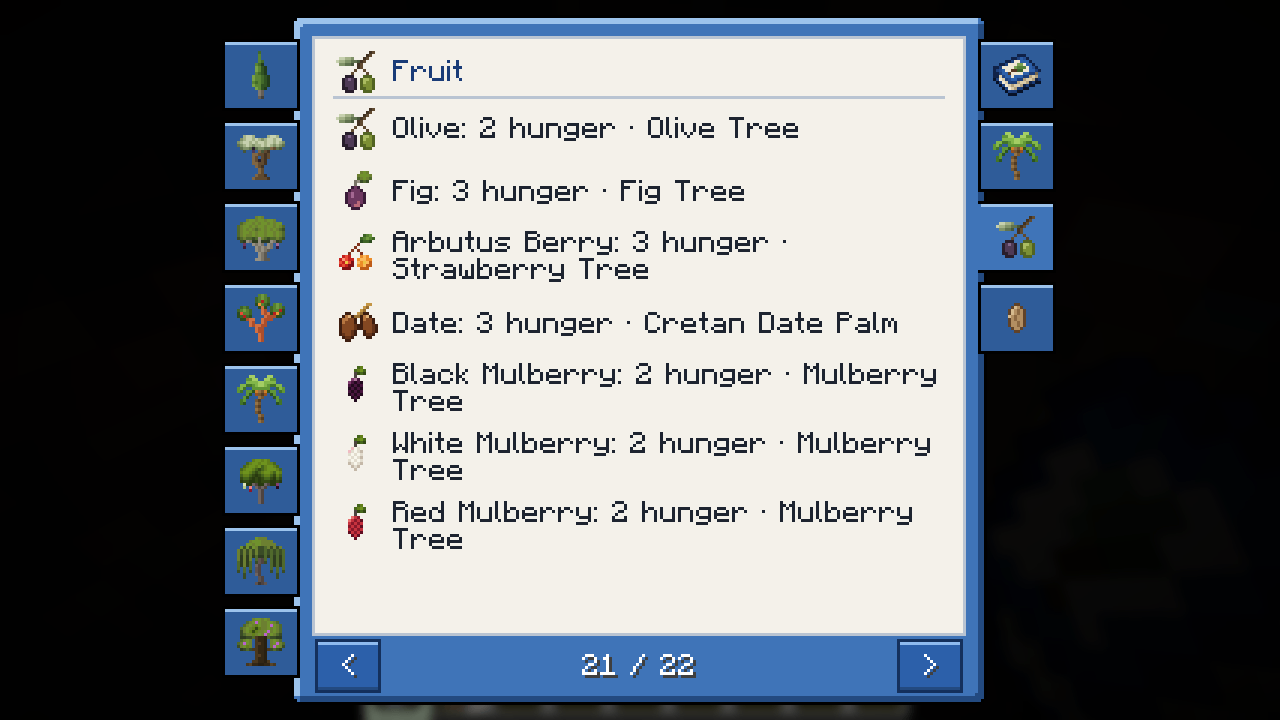
| Fruit | Hangs on | Food | Extra |
|---|---|---|---|
| Olive | twigs under the olive crown | 2 hunger, good saturation | eating it leaves an Olive Pit |
| Fig | twigs under the fig crown | 3 hunger, good saturation | |
| Arbutus Berry | twigs under the strawberry tree crown | 3 hunger | |
| Date | clusters on the trunk under every palm crown | 3 hunger | |
| Black, White and Red Mulberry | twigs under the mulberry crown, one kind per tree | 2 hunger |
A grown tree carries its fruit at mixed stages (olives green, yellowish, black; figs green, blushing, purple; arbutus berries with white flowers, yellow and orange, red; dates green, yellow, brown; mulberries all white-green at first, then black ones red and black, white ones cream and white, red ones pink and deep red). Fruit ripens in three stages on random ticks like cocoa, or with bone meal.
Breaking the leaves of a grown tree now and then drops its fruit (12 %, more with Fortune; not with shears or Silk Touch). The leaves are vanilla blocks, so the mod tells them apart by what is within five blocks: jungle leaves near jungle wood (palms), azalea leaves near oak wood (olives), mangrove leaves near stripped acacia wood (strawberry trees), jungle leaves near pale oak wood (mulberries, of the kind whose twigs hang nearby), azalea leaves near a fig twig (figs; the fig shares wood and leaves with the cypress). Vanilla jungle, azalea, mangrove and pale oak trees are made of logs and drop nothing extra, cypress leaves drop no figs and palm leaves no mulberries. Leaves that decay after all of the tree's wood is gone drop no fruit.
Right-click harvest mods: the twigs keep their ripeness in a property called stage, not age, because such mods
(Simple Harvesting, for one) treat any block with an age property as a crop and pick it at every stage. Date
clusters are cocoa to them: they harvest only ripe ones and replant them, which matches the rules above.
Eating an olive leaves an Olive Pit. It is thrown like a snowball, by hand or from a dispenser, and hurts for 1.5 hearts. Two pits on top of each other in the crafting grid (shaped) make a Sharpened Olive Pit, which hurts for 3.5 hearts. Both break on impact.
Source and issues: https://github.com/david-stefan-hermann/greek-trees
MIT, see LICENSE. By BaconCakeFactory.