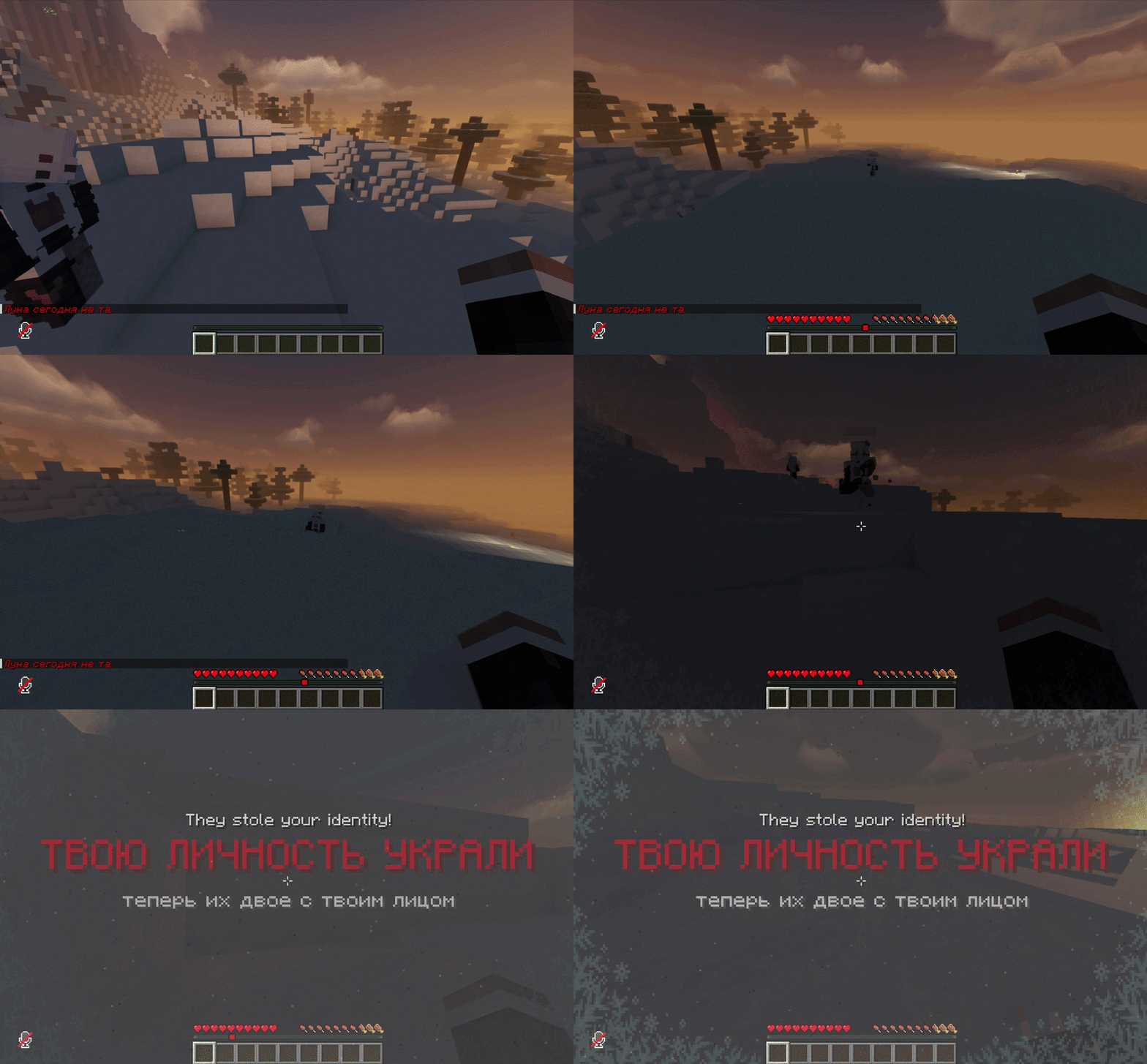
A stranger hides among your friends.
It wears a friend's face, a friend's name — and speaks in your friend's own recorded voice.

🚧 This is an ALPHA
FakeFriend is early. It works, it is played, and it will still have bugs — including ones that show up mid-game: an impostor that gets stuck, a voice clip that does not play, a Purge Night that behaves oddly. Nothing here can corrupt your world, but do not put this on a server you are not willing to restart.
Please report what breaks. A bug you tell me about gets fixed; one you quietly uninstall over does not.
| Stage | Alpha — expect bugs |
| Minecraft | 26.2 |
| Loader | Fabric 0.19.3+ · Fabric API 0.160.0+ · Java 25 |
| Sides | Client and server — both need the jar |
| Needs | Simple Voice Chat — not bundled, install it yourself |
| Players | 2+ for the impostor to appear on its own; singleplayer works for testing |
| Languages | English, Russian |
| AI | Optional. 1.4–2.2 GB, downloaded once, runs locally, offline afterwards |
| Your voice | Stored on the server only. Consent required. Erasable at any time |
| World | No world-gen changes, no new blocks or items, no recipes |
| Licence | All rights reserved |
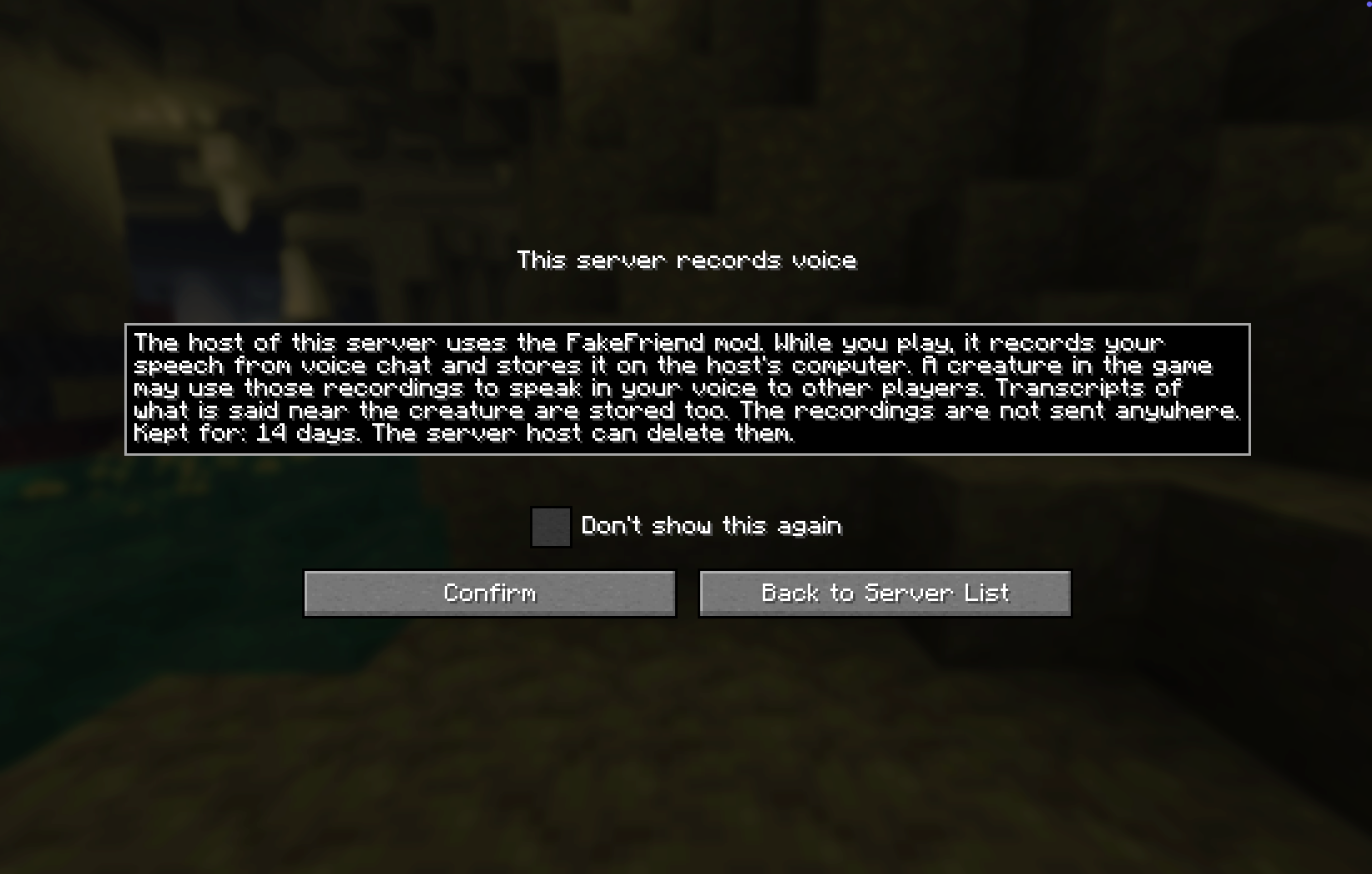
FakeFriend records short clips of what players say in Simple Voice Chat, so the impostor can speak in a real player's voice. Nothing else would work — a synthesised voice is not your friend's voice, and the whole mod is built on that difference.
Before you install, know this:
If strangers play on your server, tell them. It is their voice.
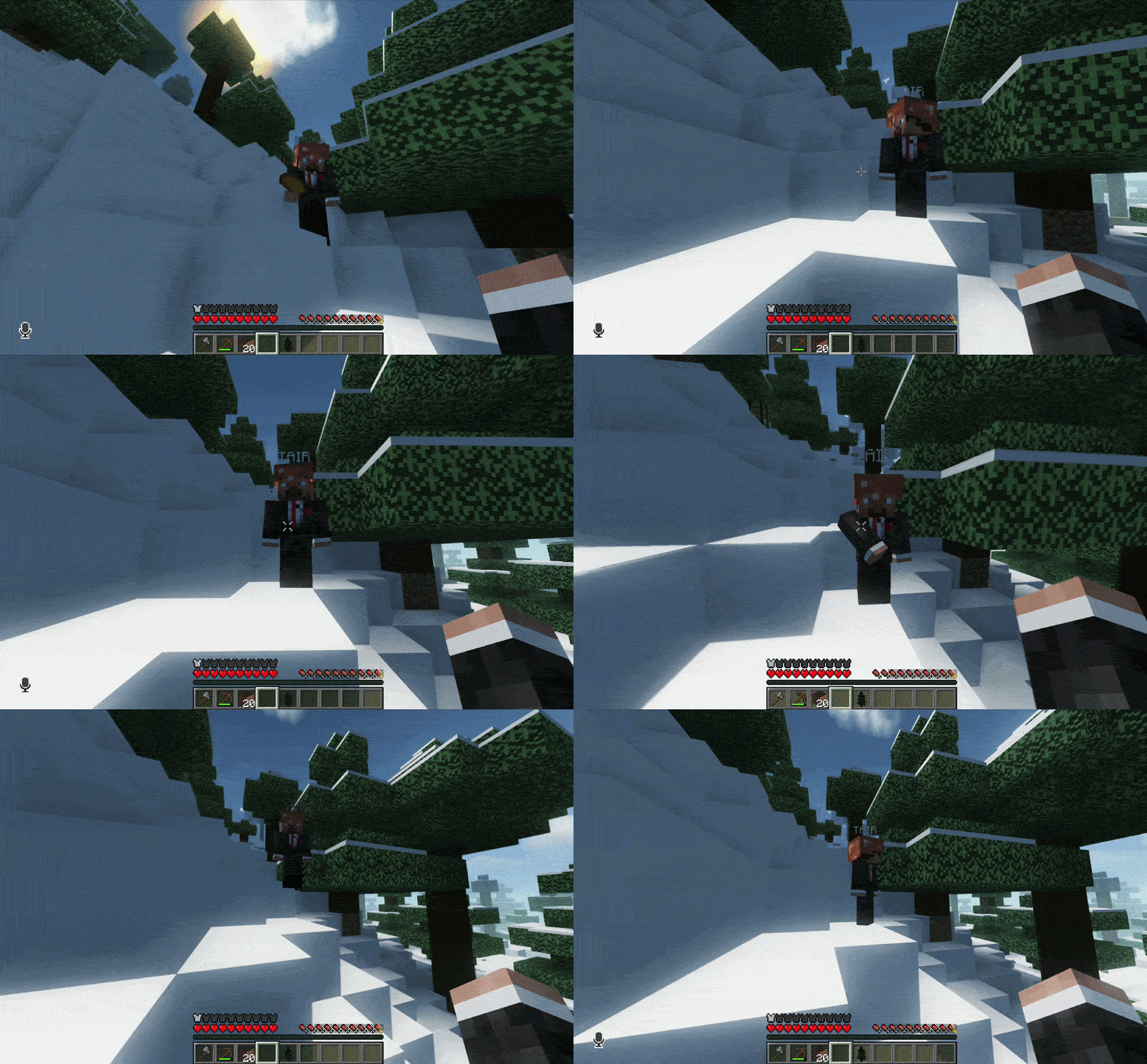
The mimic copies a player who is online right now — their username above its head, their armour, the item in their hand. Health-bar mods read it as friendly and green.
The server checks once every 15 minutes. All of this has to be true at the same moment:
Then it rolls a 45% chance. At most two mimics exist on the whole server at once, and one victim never gets two.
It walks at a player's walking speed — 4.317 blocks per second, exactly. No sneak-crawl, no sprint bursts. It only speeds up behind your back.
Every few seconds it picks up a chore: fells a tree, mines, sets a block down, walks over to grab something that dropped, puts down a crafting table and fiddles with it. Each encounter rolls it a temperament and four to six quirks out of eight — turning away sharply, bored hopping, freezing, backing off two steps.
It does not meet your eyes.
Punch it while it is calm and it flinches, drops what it was doing, turns round and yelps — in that player's voice, out of a real recording. Nothing it says is synthesised. Every sound is a clip of a real person, chosen.
It hears what is said near it and picks the recording that actually answers, instead of one at random. Say "you're a mimic" out loud and it denies it — twice, in your friend's voice.
The third time it agrees.
And then it turns.
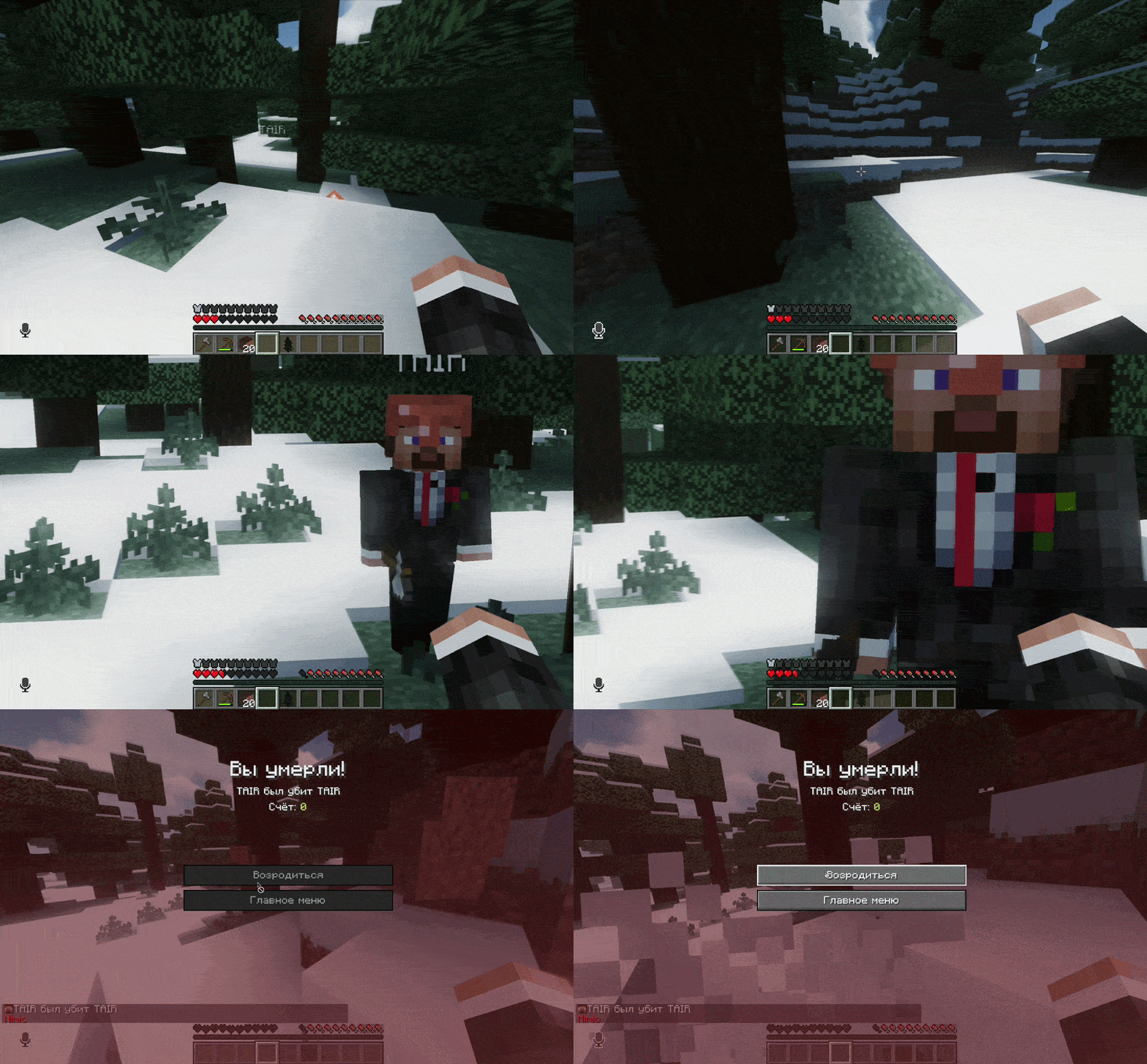
An iron axe appears in its hand. Its health snaps back to full in front of you. It screams, using the loudest real recording it has of the person it is pretending to be. Its body starts to shake, and it comes after you in silence.
An angry mimic cannot be killed. Except on one night.
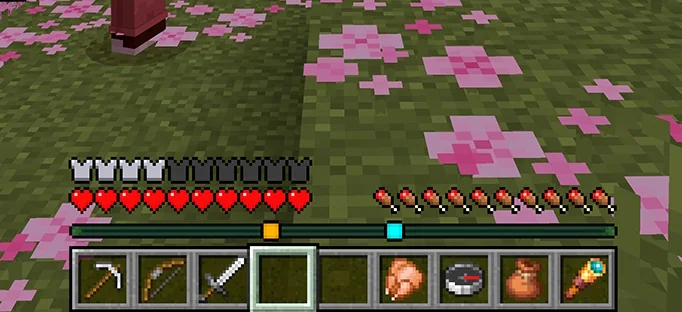
On the Player Locator Bar the real player's dot is moved onto the mimic, so the bar tells you your friend is standing right there. Nobody else's bar changes.
There is no timer and it does not die of old age. The encounter simply ends — the mimic is gone, with a sound — when:
That is deliberate. Nobody should ever be able to say "come and look, there's a second Sasha standing over here."
Somewhere between the 10th and the 15th day of the world, and then every 10–15 days after, the moon comes up wrong. The date comes from the world seed — leaving and rejoining will not reroll it — and the night needs at least two players online.
If you pay close attention, you’ll notice a warning. A month before this happens, a lone figure appears at the edge of the rendering area, simply standing still. If you approach it, it turns around and walks away. As night falls, those who don’t leave begin to appear.
They watch you, mimicking your movements for a while. Don’t let them stare at you for too long, for they are learning, bringing the Purge Night closer…
Then, one day before the fateful night, they all leave—this is announced in the chat.
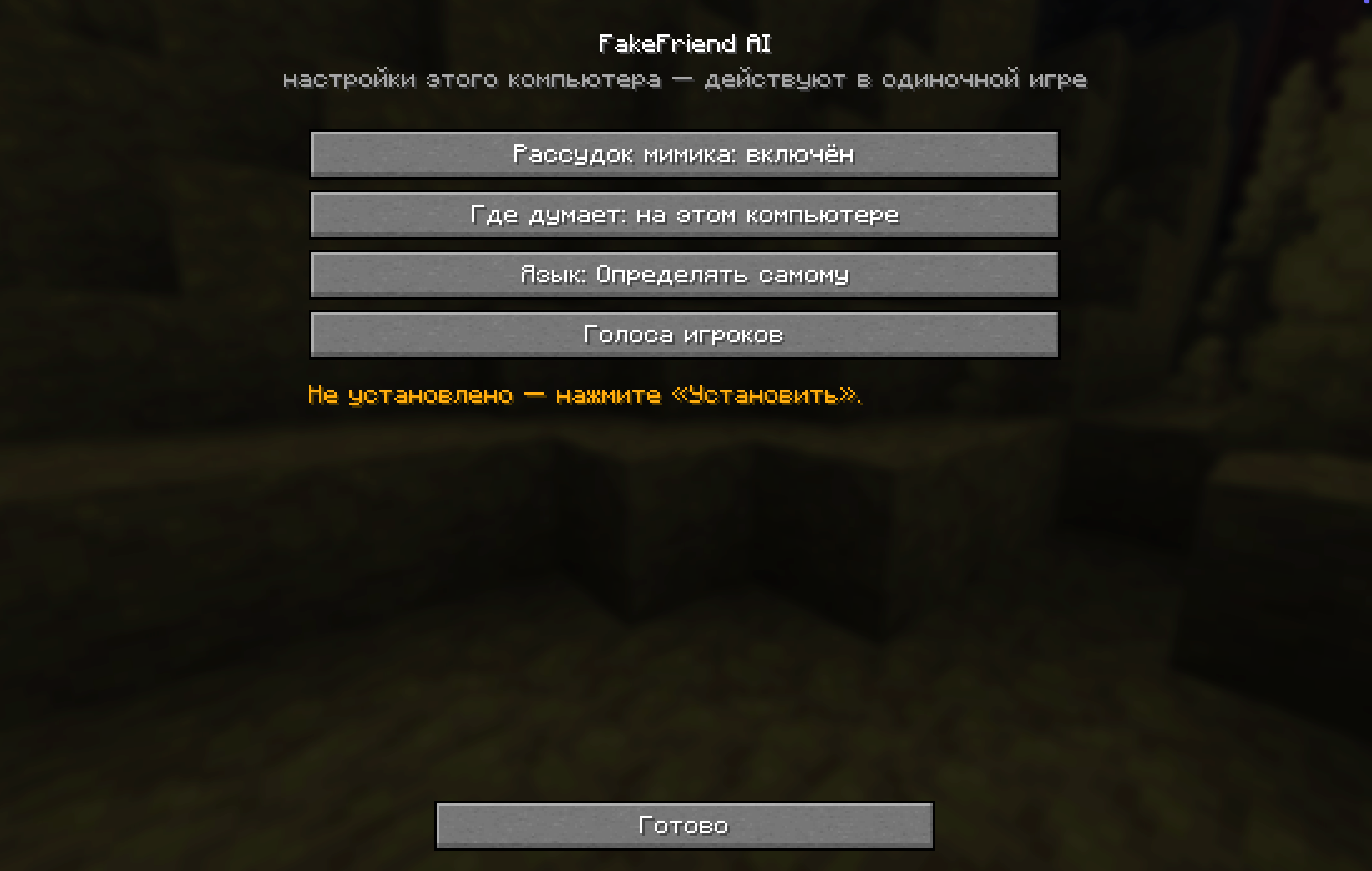
The impostor can hold a conversation: it hears you, picks the recording that answers, and plays it. That needs a small language model, and it is entirely optional — without it the mod still works, the impostor just speaks at random.
If you turn it on, the mod downloads once, onto your own machine:
| what | what for | licence |
|---|---|---|
llama.cpp b11026 |
the inference engine | MIT |
| Qwen3-1.7B | picks which recording answers | Apache 2.0 |
whisper.cpp b5130 + model |
hears what you said | MIT |
Between 1.4 and 2.2 GB, depending on which quality you pick. It all runs on your machine, in a separate process, and nothing is sent anywhere. The engine shuts itself down after a few minutes idle and starts again when needed.
On macOS the speech side stays external: run your own recogniser and point the mod at it.
Client and server both need the jar.
FakeFriend is made by one person. If it scared you, that is the best thanks — and if you want to go further:

FakeFriend is all rights reserved. The full list of third-party components it downloads — with versions, sources and licences — ships inside the jar as THIRD-PARTY.md.
All sounds and images in the mod were made by the author. No Mojang assets are bundled.