A connected-textures and baked-model library for Fabric and NeoForge, and a fork of Athena by ThatGravyBoat and Terrarium Earth.
CTM Reborn exists for one reason: to keep the Athena format alive on current Minecraft versions so that Chisel Reborn and every resource pack ever written against Athena keeps working while upstream Athena is between releases.
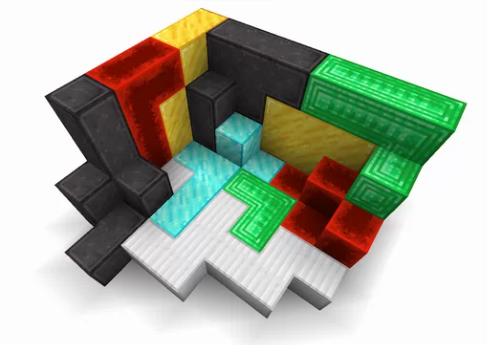
Demonstration image from Connected Textures (CTM) Overhaul, released under CC0-1.0.
Look at the borders. Vanilla Minecraft draws every block with the same texture, so a wall of one material reads as a grid of repeated tiles with a seam at every boundary. With connected textures, each block asks its neighbours what they are and picks a different sprite depending on the answer — so the grooves and edges trace the outline of the whole shape instead of every individual cube.
The red, green, cyan and white regions above are each many separate blocks. The framing follows the silhouette of each region, corners turn where the region actually turns, and interior faces come out clean. That is the entire idea, and the Athena format is a way of describing it in JSON.
Not a reimplementation, not a rewrite, not a clone of the format. The code in this project is Athena's code. The connected-texture logic, the model types, the format parsing, the quad generation, the platform hookup — ThatGravyBoat and the Terrarium Earth contributors wrote all of it. CTM Reborn carries that implementation onto newer Minecraft versions and keeps it building. The changes here are version compatibility and maintenance; the substance is theirs.
Athena is a genuinely well-designed library. The format is compact, the model types cover the cases packs actually need, and the connection-condition system is more expressive than it first looks. None of that is our work, and nothing here is presented as an improvement on it.
The fork is a stopgap, not a replacement. It is published under Athena's own MIT license with its authorship intact, and the intent is to deprecate CTM Reborn the moment Athena updates to these Minecraft versions.
Model definitions live at assets/<namespace>/athena/<block>.json and are tagged with the loader
they use:
{
  "athena:loader": "athena:ctm",
  "ctm_textures": "mymod:block/marble_[$index]",
  "connect_to": { "type": "sameBlock" }
}
They can also be written inline in a blockstate file, using the athena:athena block-state model.
| Loader | Use |
|---|---|
athena:ctm |
Standard full-block connected textures |
athena:carpet_ctm |
Flat, carpet-like blocks |
athena:pane_ctm |
Panes and glass panes |
athena:pillar |
Blocks that connect along an axis |
athena:limited_pillar |
Pillars with a restricted connection set |
athena:pane_pillar |
Pane-shaped pillars |
athena:mural |
One image spread across a width × height grid of blocks |
athena:giant is the original name for athena:mural and still works.
ctm_textures accepts three shapes, and the format picks based on what it sees:
"mymod:block/plain". One texture, no connection logic."mymod:block/marble_[$index]". The classic full CTM set; [$index] is filled in
with 0–46, one sprite per neighbour configuration.particle, center, vertical, horizontal and empty.
Each block face is drawn as four quadrants assembled from those five sprites, which gets you
convincing connections from a handful of textures.Any of the three can also be given per-face, with an optional default:
"ctm_textures": {
  "default": "mymod:block/side_[$index]",
  "up":      { "particle": "...", "center": "...", "vertical": "...", "horizontal": "...", "empty": "..." }
}
connect_to decides which neighbours count as connected. It defaults to sameState.
| Type | Connects when the neighbour... |
|---|---|
sameState |
is the exact same block state |
sameBlock |
is the same block, any state |
state |
matches a given block and optional properties |
tag |
is in a given block tag |
not, and, or, xor |
combine other conditions |
These nest, so a condition like "any block in this tag, but not if it is powered" is expressible directly in the pack.
Faces can carry a tint — either a fixed colour or a tint index resolved through the usual block colour handlers — so grass-like and foliage-like blocks connect and stay biome-coloured.
assets/<ns>/athena/ file and keys it by the
athena:loader field, so a pack can define models for blocks from mods it does not ship.CtmState: eight boolean neighbour checks — up, down, left,
right and the four diagonals — evaluated through the block's connect_to condition. That state
selects the sprite or the four quadrant sprites.CustomUnbakedBlockStateModel plus a model-loading
plugin; NeoForge registers through RegisterBlockStateModels with a small ModelBakery mixin.
Everything else is shared.The mod id is ctm_reborn, but nothing a pack depends on changed:
assets/<namespace>/athena/.athena:loader key still works, alongside ctm_reborn:loader.athena: and ctm_reborn:.provides: ["athena"], so mods depending on Athena are satisfied.
NeoForge has no equivalent mechanism, so mods there that hard-require the athena mod id will
not see it.| Branch | Minecraft | Platforms |
|---|---|---|
main |
26.3 | Fabric and NeoForge |
26.2 |
26.2 | Fabric and NeoForge |
MIT, inherited from Athena.